
Screenplay Scene Headings: INT., EXT., and I/E Explained
In screenplay scene headings, INT. and EXT. stand for interior and exterior, respectively. You use INT. when the scene takes place inside a location and EXT. when it occurs outside.


What INT. and EXT. Mean in Screenplay Formatting
In screenplay scene headings, INT. and EXT. stand for interior and exterior, respectively. You use INT. when the scene takes place inside a location and EXT. when it occurs outside. Most of the time, determining which to use is straightforward:
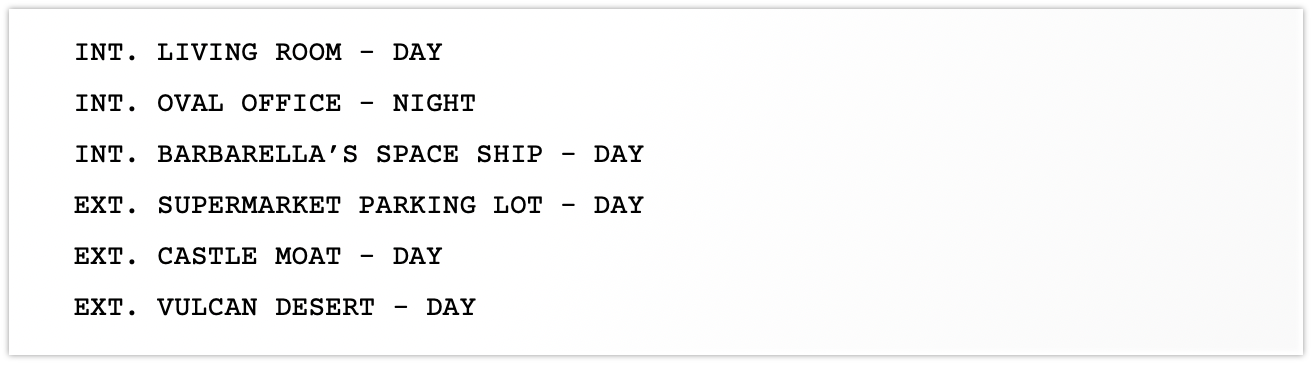
Sometimes, a situation will arise where it’s not clear which one really makes more sense. For instance, you’re clearly

but are you INT. or EXT. for the Superdome? Or what if a character is using a phone booth? In both cases, it’s your call. Just be consistent. And for scenes that take place in a moving car, I often note it as

to indicate that we’re both inside and outside of the car during the scene.
Slugging Establishing Shots
In addition to INT. and. EXT., you’ll occasionally see EST. used in a header. EST. stands for “establishing” as in “Okay, now we’re at the Grand Canyon.” Personally, I never use it. By definition, an establishing scene wouldn’t have any real action or dialogue, so I find it clearer just to use EXT. followed by a single word of action: Establishing.
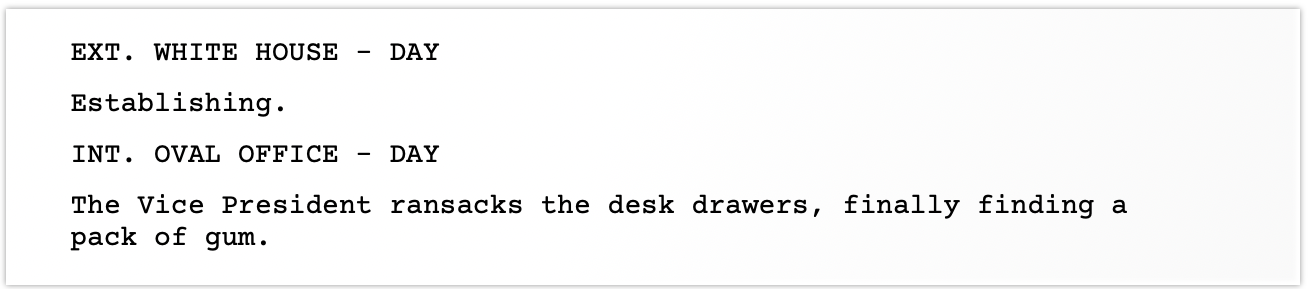
Using Both: INT./EXT.
When a scene involves action seen from inside and outside the same setting — such as a parked car or garden shed — the combined form INT./EXT. (or shorthand I/E) can be used. This signals that the action spans both interior and exterior perspectives of that location:
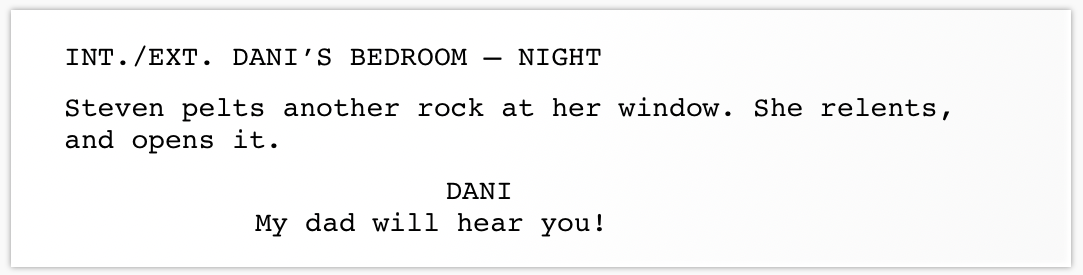
This convention helps clarify that the camera or action moves between inside and outside views without splitting the scene into two separate headings.
What I/E Means
I/E is simply a shorthand version of “INT./EXT.” used in a scene heading when the action will take place both inside and outside a location. While not as common as writing out INT./EXT., many screenwriters use it out of preference.
Despite its convenience, some writers prefer to spell it out fully for clarity. In either case, it conveys the same meaning: the scene encompasses both interior and exterior aspects of the location in question.
Supplemental Links: