🪜 #288 - Not that kind of breakdown
This week's Inneresting wants you to take smaller bites (of your work).


Narrowing your focus can make daily work more approachable. You are not responsible for writing the movie today. You are responsible for writing this one scene. You are responsible for writing how these characters enter into this scene.
– from the Scriptnotes bonus chapter "Getting Stuff Written"
If you've ever looked at your outline and a calendar at the same time to figure out how many scenes you need to write per day to make a deadline, these links might come in handy. Breaking a larger story down into beats or scenes can be a planning tool as much as it is a tool for structuring narrative.
The Decision Lab explains The Planning Fallacy, including how breaking a task down into smaller tasks makes people better at estimating how long tasks will take. Instead of having a vague idea of how much you need to write and how long that could take, you can create a more accurate schedule for yourself and better estimate the total time until completion (and make sure you hit your deadlines).
Alice Boyes explains general strategies for decomposing larger projects, including the benefit of encapsulation. Instead of sending your brain in five different directions about how this scene impacts other scenes, treating it as its own task to complete allows you to come back to it later to address those concerns instead of needing to make a scene perfectly connect to everything else on the first try.
But what happens if you get stuck breaking things into smaller and smaller pieces, or getting stuck in a loop of endless outlining? Abbie Emmons introduces The Staircase Method, the idea that you only outline the next few steps ahead and wait until you've written yourself to the end of those steps before outlining further. This not only breaks things down into smaller, concrete writing tasks, but avoids the potential overwhelm of a long list of little things to do.
So once you have your smaller steps defined, how to you keep your focus locked only to the step you're working on?
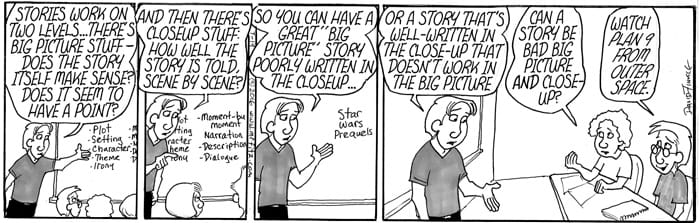
David Lee Finkle uses the mental model of thinking about stories either in Big Picture or Close Up. By keeping things in the Close Up view, writers are able to focus on the immediate moment they're writing instead of juggling thematic concerns or information about every step in a plot thread.
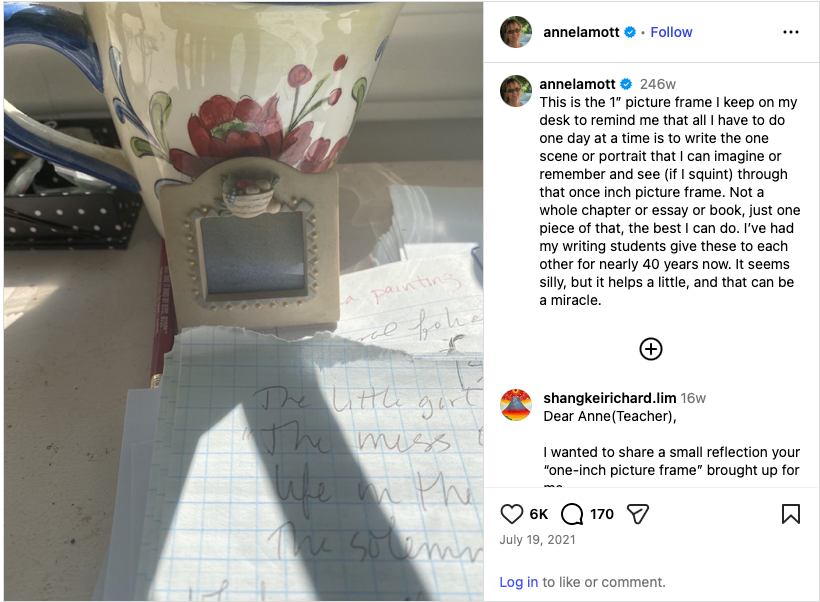
Anne Lamott keeps a one inch picture frame on her desk as a way of focusing on one next scene or portrait:
Cathy Kirch recommends keeping a distraction pad handy so your working memory doesn't get taken up with ideas unrelated to the writing at hand.
And let's not forget the value of a Write Sprint, where carving out a specific block of time sets a subconscious cue to put one word in front of another until the timer ends instead of getting lost in thought.
Because that's how writing gets done: Words on a page. You know you can't dump them all out of your brain at once. Even knowing that, your subconscious might want you to bite off more than you can chew (or judge you for not moving faster).
Creating a stepped-out plan or finding clear mental triggers can help you mindfully focus on just the writing you're presently doing.
👋 Are you new here?
Inneresting is a weekly newsletter about writing and things that are interesting to writers. Subscribe now to get more Inneresting things sent to your inbox.
And if you can't wait until next week for more Inneresting, check out the Quote-Unquote Apps Blog where we keep previous issues and other posts about screenwriting and things interesting to screenwriters.

In case you missed it...
In the most clicked link from our last issue, Anil Dash sounds the alarm on how LLMs are dismantling what’s left of the open web (and what you can do to counter it).
What else is Inneresting?
- LA Johnson illustrates what intrusive thoughts feel like, and how to manage them.
- Mason Currey on the difficulties of being a writer with social anxiety.
- Zeb Larson on the peril of government digital infrastructure built on COBOL, the most widely adopted programming language in history.
And that’s what’s inneresting this week!
Inneresting is edited by Chris Csont, with contributions from readers like you and the entire Quote-Unquote team.
Are you enjoying this newsletter?
📧 Forward it to a friend and suggest they check it out.
🔗 Share a link to this post on social media.
🗣 Have ideas for future topics (or just want to say hello)? Reach out to Chris via email at inneresting@johnaugust.com, Bluesky @ccsont.bsky.social, or Mastodon @ccsont@mastodon.art
If you don't know what to write...
make a list (just the list) of what your protagonist plans to do after they succeed with their main goal. Even if it's just going to Disney World, what needs to get done before it can happen?