A Taster's Choice Moment: Inviting Vulnerability in Good Will Hunting

It's emotionally healthy for a character to allow themselves some vulnerability with other people. That doesn't mean every character wants to, and it doesn't guarantee that this is an important goal for every character.
If it's important to the character's story, learning to let their guard down and become vulnerable can make for some challenging, dramatic scenes. Take Good Will Hunting...
Will Hunting needs to find a therapist for a mandatory number of sessions to avoid jail time. This seems like a pretty easy argument for quickly discovering a desire to start psychotherapy. But Will has a much stronger desire to not expose himself that's strong enough to make him taunt a series of potential therapists and jeopardize his freedom.
And then he meets Sean Maguire...
Will went into this appointment with a deck of Uno: Oops, All Reverse!
Not the best first session for either of them. Sean keeps attempting to get Will to answer basic questions, but Will ignores and stonewalls him the entire time. Sean knows he can't do anything if Will isn't interested in talking about himself, and he also knows it's not sustainable to end meetings with a chokehold. Will lacks a capacity for vulnerability.
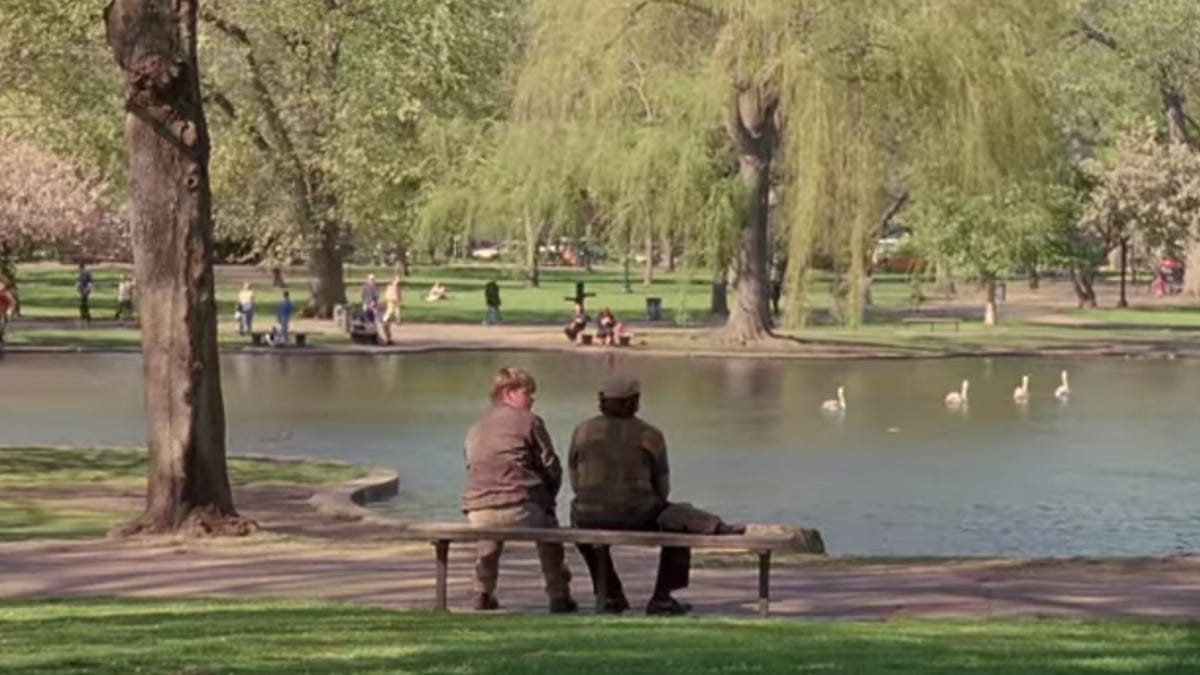
And the first step for that in their next session is to get away from the space that carries the negative impressions from their first meeting. So let's take a seat in the Public Garden.
FYI this bench is still there. It's a nice place to sit.
Will attempts to make this a continuation of his previous tactics, deflecting and cracking wise:
"So what’s this? A Taster’s Choice moment between guys? This is really nice. You have a thing for swans? Is this a fetish, like is this something we need to devote some time to?"
This intro both reminds the audience of what Sean is up against, but also shows the way that Will attacks the idea of therapy. He likens it to a commercial, full of obviously constructed schmaltz and false intimacy. And he gets in his snarky dig about the swans to see if that raises some hackles.
Will denies the premise of therapy: that self-examination will be of any personal benefit.
So Sean directly addresses their first meeting as a way of dismissing Will's defensive performance:
"I stayed up half the night thinking about it and then something occurred to me and I fell into a deep peaceful sleep and haven't thought about you since."
Sean delivers his thesis statement: "You're just a kid. You don't have the faintest idea what you're talking about."
This isn't only to call Will out. Sean structures an argument around a central conflict between Experience and Knowledge. Throughout the film, multiple characters choose sides in this fight, whether it's Skyler reprimanding Will for doing her homework because she needs to understand it (value of experience), or Will attempting to defend himself in court with legal precedents from the 1700s (knowledge) against a judge who sees through the obfuscation and addresses the crime in the present (experience).
Because Sean recognizes a kid who's never strayed too far from Boston.
So if I asked you about art you could give me the skinny on every art book ever written... Michelangelo? You know a lot about him. Life’s work, political aspirations, him and the Pope, sexual orientation. The whole works, right? But I bet you couldn’t tell me what it smells like in the Sistine Chapel. You’ve never stood there and looked up at that beautiful ceiling. Seeing that.
The choice of detail here gives a twist to the audience's expectation. If you're asked about the Sistine Chapel, is the first thing that comes to mind its odor? Sean's getting at the value of experience even in these small choices.
And he continues, bringing up his expectations of Will's thoughts on women and war, but then the tactic changes with the subject of love:
And if I asked you about love you’d probably quote me a sonnet, but you’ve never looked at a woman and been truly vulnerable. Known that someone could level you with her eyes. That God had put an angel on Earth just for you. Who could rescue you from the depths of Hell. And you wouldn’t know how it felt to be her angel. To have the love for her be there forever. Through anything. Through cancer. You wouldn’t know about sleeping sitting up in a hospital room for two months holding her hand because the doctors could see in your eyes that the terms “visiting hours” don’t apply to you.
Sean directly calls out Will's lack of vulnerability, but encases it within another topic. It's conversational sleight of hand, where Sean wants to make a crack in the walls Will built around himself, but doesn't want to get caught doing it just yet.
But Sean's generalized calling out of Will now turns to Sean's personal life. All those things Will said about Sean's wife? Now Will gets to know the real story. But see how the second-person-style phrasing keeps the focus on Will, even though it's Sean's story. Sean is deploying his experiences in a way to demonstrate to Will what he has and what will lacks because Sean is capable of letting his guard down and letting other people in.
But Sean can't avoid the elephant in the room, and so he brings the tough love:
You don't know about real loss, because that only occurs when you love something more than you love yourself, and I doubt you've ever dared to love anybody that much. I look at you, I don't see an intelligent, confident man. I see a cocky, scared shitless kid.
All of the times we see Will deploy his knowledge before this point has been in service of himself. He argues in the Harvard Bar by quoting book after book to impress Skyler. He tries to avoid legal consequences for his actions. He runs rings around multiple therapists to make them feel small and annoyed.
Sean sees through the edgelord bullshit and tells Will he's a coward. Someone afraid of putting his brain to work for a bigger purpose, or even afraid to step into the arena and experience real love.
But you're a genius, Will. No one denies that. Nobody could possibly understand the depths of you. Yet you presume to know everything about me because you saw a painting of mine and you ripped my fucking life apart. You're an orphan, right? Do you think I'd know the first thing about how hard your life has been, how you feel, who you are, because I read "Oliver Twist?"
It's a fine line that Sean walks here, where he takes a swing at Will's ego in one moment, but then acknowledges that Will has great potential. But bringing things full circle, Sean comes back to how it's pointless to try to look at the trappings of a person's office, or the surface level similarities between someone and a fictional character and think you understand them.
"Unless you want to talk about you. Who you are. And I'm fascinated. I'm in. But you don't want to do that, do you sport? You're terrified of what you might say. Your move, chief."
This play at the end shows how much Sean understands who he's up against. It's a combination of offering safety by admitting his enthusiasm for getting to genuinely know Will, and then following it up with a challenge to Will's confidence.
Almost like he's calling Will out, asking "You think you're so tough, but are you tough enough to express your feelings through open dialogue? Huh?"
Sean's goal in this scene is getting Will to participate. He can't knock the walls down for Will, but he can show him that they don't need to stay up forever.
Vulnerability isn't earned. It's not a quid-pro-quo. Sean isn't trying to make a trade with Will, but models what it looks like when someone feels safe enough to share.
Takeaways
- Vulnerability isn't a goal. It makes other goals accessible. How can your character letting their guard down give them a path to obtaining something they desire? What forces them to confront how guarded they are?
- Who's the guide for the protagonist on this emotional expedition? What possible model is there for how the protagonist could be after letting their guard down? How does the protagonist respond to the idea of this role model?
- Look for echoes. Are there other characters in the protagonist's life also struggling to be vulnerable? For example: Chuckie offers a small moment of vulnerability in an attempt to push Will to get out and do something more with his life.
Friendship goals.