Scriptnotes Recap: Ep. 753 - The One with Aaron Sorkin
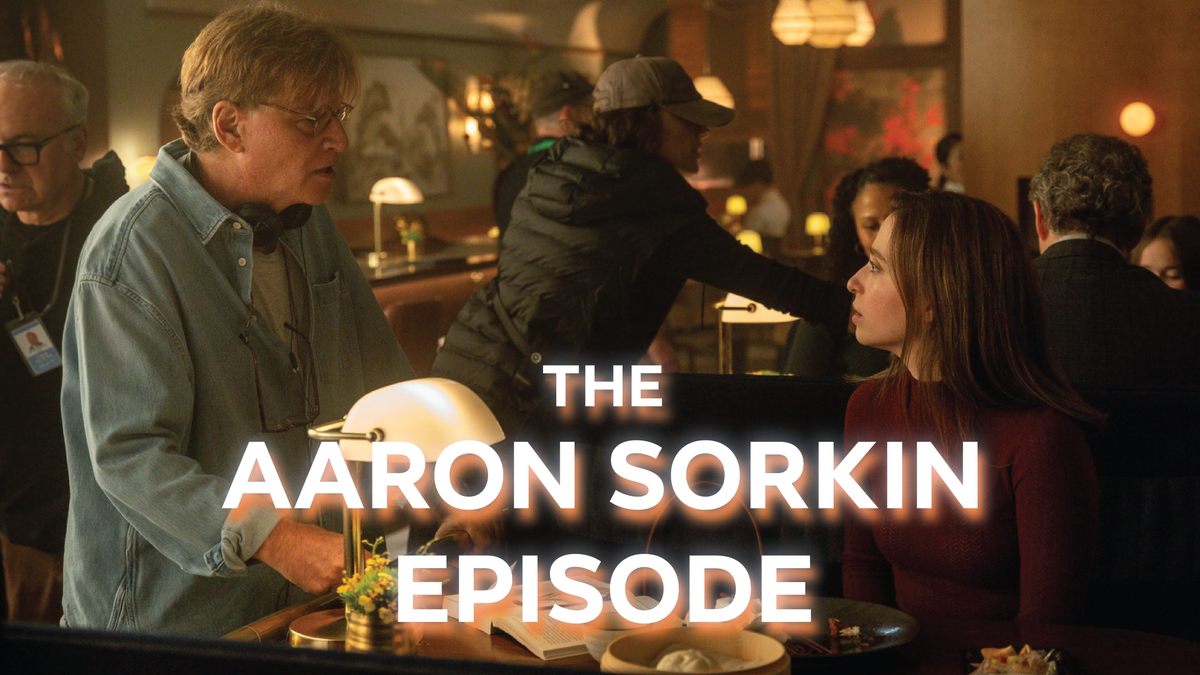
Aaron Sorkin is prolific. Even my friends who “don’t really know film” know Aaron Sorkin. That’s why it was so exciting to finally welcome him as a guest on this episode of Scriptnotes, with the debut of his new film, The Social Reckoning, right around the corner.
The Social Reckoning is based on The Wall Street Journal’s 2021 investigative series, “The Facebook Files.” And though it is not a sequel per se, it’s a spiritual follow-up to Sorkin’s Academy Award-winning powerhouse, The Social Network.
Sorkin is widely known for writing within the political and current events world (The West Wing, Moneyball, The Trial of the Chicago 7). This is to say, many of his characters resemble — or more than resemble — real people. During his time on Scriptnotes, Sorkin beautifully described his approach to pulling from real life. His movies aren’t a photograph. They are a painting.
He’s not a fly on the wall, reporting with 100% accuracy everything that’s been said, verbatim. It’s his job as the writer to paint the picture for us— to make us feel these characters and the gravity of their situations. (See: His changing Zuckerberg’s beer to a vodka & orange juice.)
And, if you’ve ever wondered: Does Aaron Sorkin write outlines? You’ll be pleased to hear we get to the bottom of this question. (He does not.) As I can now imagine, Sorkin begins with scenes (Dialogue! His bread and butter!), and building from there, the outline reveals itself. It’s as if he’s walking through the dark woods with a flashlight.
A negotiation, a fight, a seduction, or a discovery — he says every scene must be one of these four things. This episode of Scriptnotes is full of discoveries. There are so many golden nuggets of advice, I encourage every budding writer to listen.
Intention and Obstacle
John: With your blessing, I really want to focus in on craft because my thesis, which you can feel free to dissect and pull apart, is that I think what makes your writing so singular is you are so good at choreographing conflict within a scene. You can set up situations in which characters get to wrestle with an idea, and we get to enjoy them playing with an idea.
Aaron: That’s really nice of you to say. I cling like a life raft. I cling to intention and obstacle. Somebody wants something. Something’s standing in their way of getting it. I need that before I can write a scene.
John: Do you enjoy writing, or is writing a thing you have to do to get through to get to the next stage?
Aaron: I know that there are some people who say they don't enjoy writing; what they enjoy is having written. I enjoy writing. What is agonizing is not writing. If you were just to take a section of time where we could say legitimately that I began here and I finished here, most of that would be time not writing.
Most of that would be climbing the walls, pacing around, I don't know how to start, I haven't found the intention or an obstacle, I'm googling how to fake your own death, but when I am able to write, when I do have that intention or an obstacle, when I'm loaded up and can write a scene with energy, it's not coming out like ketchup; it's really, I've got it now, that feels great.
John: Has your process changed a lot over the course of your career? The Aaron Sorkin who's writing A Few Good Men versus the Aaron Sorkin who's doing The Social Reckoning, are they the same writer?
Aaron: Yes. In that, I don't write an outline. I hope no one hearing this is taking this as a recommendation. If you can write an outline, yes, sure, go ahead. What I do is—and this is after a long period of time of not doing anything—when I can get there, index cards and a corkboard. It's kind of like walking through the woods at night with a flashlight. You can only see as far ahead as the beam will go, but the further you walk into the woods, the more you can see. If I know what the first three scenes are going to be, I'll put those index cards. I don't dip my toe in.
I really have to know what that first scene is, almost to the point where writing it is kind of an afterthought. It's almost secretarial because I've got the scene. When that happens, again, it's a joy. I'm very physical when I'm writing. I say everything out loud. I'm the first person to play all the parts. I'm not waiting until I have an ending.
I don't have that kind of patience. The difference between being on page 1 and page 0 for me is life and death. I want to write that first scene, not just because I want to get started, but because I want to show off a little bit. I've written that first scene. I really like it. The only way anyone's ever going to see it is if I write the 100 scenes that come after that. That's how it goes.
John: One of the things I've noticed about your scenes is, in the middle of a scene, you'll introduce an idea that is orthogonal to the main point of it. It doesn't seem to be related, and yet the characters will keep grabbing onto that as a handle to recur. Is that a thing you recognize in yourself?
Aaron: It is, yes. I recognize doing that. Here's something that I don't do. From time to time, I get a chance to speak to students, screenwriting majors in college. They'll talk to me about theme. Theme isn't really something I think about until the end. It sort of presents itself. When I go in, I'm not thinking, "Well, the theme is," and "How do I--" I don't know how to write a theme. Again, I can only write intention and obstacle. As you walk through the dark woods with the flashlight and you can see more as you go, I will see that a theme or themes have presented themselves.
I'll decide, "I like that theme." When I go back now and write the second draft, I'm going to hang a lantern on that, cut away the stuff that didn't have anything to do with that.
By the way, the other thing that I don't do is I won't start rewriting until I get to the end. Here is a recommendation. I really encourage young writers: get to the end, get to a fade-out. Even as you're going, if you realize, "That wasn't good, that wasn't good," get to the end.
You're going to know a lot more about what you're writing when you get to the end, and then go back to the beginning and write it knowing what you know about the piece.
John: As you sit down to do a day's work, are you reading the scenes before this? Are you running your fingers through the scenes before this, or are you starting clean on a new scene?
Aaron: I'm going through the couple of scenes that come before. I don't have to read them. I know them. I really believe in writing with energy. It becomes physical energy. If you are mentally prepared to write the scene, which is to say if you know what this person wants in the scene, if you're really prepared, then the energy that you write it with, it can make its way onto the screen.
I got to spend a couple of years with Mike Nichols, which was like, yes, you're just getting paid to go to grad school. He says that every scene has to be one of four things, and I just want to remember what they are. A negotiation, a fight, a seduction, or a discovery. That every scene has to be one of those four. A discovery that's either a discovery for one of the characters or a discovery for the audience: "Oh my God, there's a bomb under the table."
Oh, another recommendation. If it's going well, end your writing session in the middle. Don't get to the end of the scene. If you can, end before the punch line to a joke so that when you wake up the next morning, you don't have any thinking because you know exactly what you're going to do. You're excited about it. You know what it's going to be.
Dialogue Is Music
John: Let's talk about the choreography, which comes down to me; it's the punctuation, it's the stops, it's the starts. These are all in your script, and yet it's also coming out of the actor's mouth. Talk to us about the choreography and figuring out the tempos on the page so that actors have a thing to hold onto.
Aaron: You're using all the right words because, for me, dialogue is music. What a line sounds like is as important to me as what it means. I think that happened because I started to love plays before I knew what they were about. I grew up in a suburb just outside New York, and my parents took me to see plays a lot, including plays that I was too young to understand: Who's Afraid of Virginia Woolf? when I was nine years old. I loved the sound of dialogue. Didn't really know what was happening in the play, but the dialogue sounded like music to me, and I wanted to imitate that sound.
The actors will know when they've dropped a syllable, and they've dropped a beat. In a sense, they'll go to the script supervisor and say, "I'm saying something wrong. I know I'm saying something wrong," which is great.
John: Well, the dialogue, I also want to stress, you're trying to connect the idea, so it's all one continuous mode of thought, but it's also so that the rhythms, that the words, they can get to the next thing, that the next word makes sense for them to have said in that moment, that it fits the mouth.
Aaron: Oh, yes, sure. It needs to fit the mouth. I want these words to be sayable by the actors. I never want it to be the actor's job to make something work. So often I'll work with an actor who I can tell, it's almost like a beaten animal that they've spent so much of their career feeling that it's their job to make something work, that someone has to say to them, "Let the words do some of the work."
The music is important to me. I've learned a new trick, and this is maybe a trick that I should have learned a long time ago. As an experiment, when you write a scene, just see what happens if you cut the last line of the scene. Just see what happens. Half the time, I'll say, "Oh, that is a cooler ending to the scene."
John: How does the writing change when you're writing for established characters week after week?
Aaron: Well, series television, except for the first episode and the last episode, it's all middle, which is a lot of fun. It's a great forum to write in.
With television, you have concrete, hard deadlines. You have air dates that you have to meet, which means you have to write anyway if you're not writing well. You have to write when you're not writing well. Then you have to put that on the table for the cast and crew for the read-through, and then you have to point a camera at it. That's a tough pill to swallow when you knew there was just a pebble in your shoe the whole time while you were writing. That's the part I don't like.
The part I do like is what you're talking about: that you can take characters that the audience now is very familiar with, and you can stretch them just a little bit that way in an episode and a little bit that way in an episode. You can put them into situations. The audience is already rooting for them. It's a different style of storytelling, one that I like a lot.
Disguising Exposition and the Important Truth
John: As you watch that scene, what do you see? What do you remember?
Aaron: I knew at the outset that part of the structure was going to be these dueling depositions. He's being sued by the Winklevoss twins here and Eduardo Saverin there. There's going to be these dueling depositions. The challenge was going to be that it just can't seem like we're constantly cutting to exposition. That'll be easy enough to just have the lawyers do a recitation of you did this, and you did that.
Disguising exposition is a skill that a writer needs to develop. It's very important. Exposition being the only part of drama. If drama is exposition, inciting action, action, reversal, climax, denouement, exposition is the only part that isn't natural. People don't generally say, "As you know, I'm a butler here, and I've been working here for 22 years." Disguising exposition was going to be the challenge. It turned out to just be fun for me.
If you can create a moment where he is being challenged by people he believes are inferior to him, which is most people, then you can usually light something up.
I mentioned a little while ago that one of my trying-to-write-things is driving around in my car listening to music. It's good for getting into arguments with myself. I would bet anything that this scene, that the end of this scene, the "do I have your full attention?" part of this scene, was the result of I owned myself there. I asked myself that question and shot back with the answer.
What I had, research-wise, was a transcript of his blog from that night. It was a Tuesday night in October in 2003. Except for changing the girl's name, I used almost word for word what he had said.
When I'm writing nonfiction, when I'm telling a true story, what am I willing to lie about? Here's an example. He says, in the transcript of that live blog that he's drunk. That he's drinking to get drunk. What I wrote was that we're on his computer screen as he comes into his dorm room. He walks in and out of the frame, booting up the computer, comes back into the frame, puts a glass down, ice in the glass, vodka in the glass, orange juice in the glass, all the while, in voiceover, we're hearing this thing.
A couple of weeks before shooting started, we found out that he was drinking beer that night, Beck's Beer to be exact. David said, "Okay, you got to change it to beer." I begged David, no, no, no, keep it vodka and orange juice, not just because it's more visually interesting making vodka and orange juice than opening a beer, but because drinking a beer doesn't necessarily read as drinking to get drunk. It can just be a college kid thirsty on a Tuesday night. The important truth isn't what he was drinking. It was that he was drinking to get drunk.
I wouldn't have had him do a line of coke. That's an entirely different thing. I'm interested in the more important truth. It's that it's not journalism. It's not a photograph. It's a painting.
Listen to the full episode on Scriptnotes or wherever you get your podcasts! The full transcript is available at johnaugust.com