My Short Film Flopped So Yours Won't Have To

After a year of festival rejections, it's safe to say my latest short film has flopped.
Don’t cry for me, reader. This is the fate of most short films. Breakthrough shorts are rare, and as the entertainment industry contracts, more and more high-profile and well-connected filmmakers are making shorts because, well, they’re not doing anything else at the moment. This, along with a now-widespread accessibility to filmmaking equipment, means the number of short films being made has skyrocketed.
In 2026, Sundance saw a record-breaking 11,480 short film submissions, from which they selected just 54 – that’s a success rate of 0.47%.
But despite knowing all this, anyone who has been through it will tell you: it's hard. Rejection from one organization can be chalked up to a difference in taste, but rejection from every organization sure feels like a consensus that you suck.
What felt like a reasonable amount of money to spend to give your career momentum now feels nauseating as you watch the project trip, hit its head, and slide face-first down a hill.
Maybe most heartbreaking of all is that no one sees your movie. Without some institutional seal of approval (specifically a big festival or major distributor), it feels destined to live... where? Seriously, where do shorts live now? Vimeo used to be the place, but now that there's no curation it's basically a fancy Dropbox link. YouTube? If you can work the algorithm, great, but I don’t see a bright future there for my social-realism chamber piece about shame. Any online rollout without a built-in audience is like trying to go down a dry waterslide.
No, this is a painfully average disaster, and it is my fault.
What went wrong?
My short had a lot going for it. It received the Panavision New Filmmakers grant and fiscal sponsorship from Film Independent, and the script was a finalist for other major grants. We got coverage online, airtime on Scriptnotes, and generous support from people at every level of the entertainment industry. John called in favors, a big manager went to bat for it, and a major post house took us under their wing. Not to mention the friends and strangers who offered up everything from snacks to services to letting us shoot in their house for free.
But no matter how many things you do right on a project, it's your missteps that determine your fate. The final product clearly left something to be desired: We submitted for twenty-three festivals and were selected for only one – a regional festival that gave us a waiver code after we paid $20 to advertise our short on FilmFreeway (n.b., don't do this.) I'm grateful to them for championing the short, but the data points are trending in the opposite way.
In the wake of the massive shrug it received, I've been trying to figure out where it all went wrong. Spinning out and obsessing is a real risk here, but learning the right lessons from your mistakes can help push you to make your next thing. Some mistakes I noticed in the moment and chose to ignore, but mostly it's wisdom I've only been able to glean through this process of striking out. Though every short's problems are different (and hyper-specific to its story and team), I thought it might be worth sharing some of those hard-won lessons so you, reader, don't have to beef it to learn them too.
1. Always do a popsicle stick version.
Not literally popsicle sticks. It's often referred to as pre-vis, but pre-vis can be so many things, and what I'm specifically talking about is using a cheap camera (phone is perfect) and filming every shot on your shot list, and then cutting it together to see if it works. Don't worry about lights or sound, it's just to make sure that the logic of your visual storytelling is there.
The first person I heard about doing it was Diane Keaton, but it's a very common technique – on Scriptnotes, Eva Victor talked about doing it for Sorry, Baby. I did it on my first few shorts, and it was incredibly helpful. You quickly learn where the pacing is weird, what inserts you might need, which scene transitions bump, allowing you to catch as many mistakes as you can before you have to do it for real.
I was an acolyte for it. But for reasons that are now insane to me, I abandoned it on this project and put my trust in an app – PreVis Pro.
This is not a secret hit piece on PreVis Pro, PreVis Pro is magic. I took my production designer's measurements of the space and bloop bloop bloop, I had a 1:1 digital set that I could light and put CGI actors on and use the exact camera at the exact focal length I wanted. I used its AR tools to walk around the set and experiment with angles, finding ways to uniquely frame my actors that I wouldn't have known existed were I not "in the room." Then I was able to share these digital storyboards with all my HODs, so everyone knew exactly what we were going for with every shot. I thought I was giving myself, and therefore the movie, an advantage.
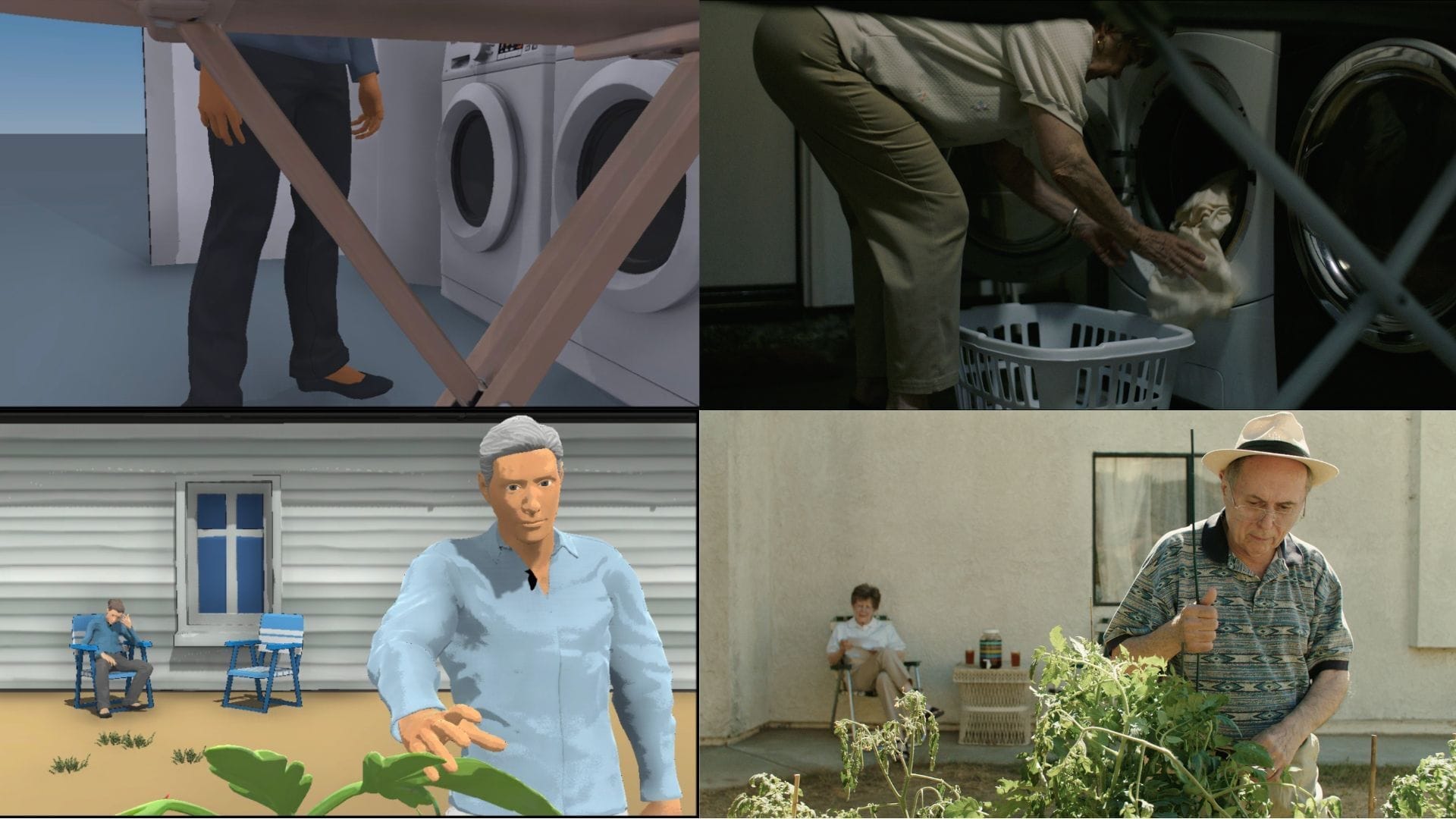
But there's a reason animators turn storyboards into animatics: You need to know how your movie feels in real time. A shot that I made (and loved) in the app, where I used a laundry board like a waterline on an iceberg to physically separate a character's shame from their ironed-out facade, was painful to actually watch because doing laundry is an excruciatingly slow process.
Time and again, I found myself stuck in a setup that looked beautiful but didn't serve the storytelling the way I thought it would. I began to doubt all of my prep work, which is the wrong headspace to get into on set. And in the editing room, I was stuck wrestling with sequences that went on too long or didn't cut together well. These are problems that could have been easily avoided had I just made the scratch version first.
2. Get coverage.
There seems to be a consensus among cinephiles that the longer a shot goes on, the better it is. Not just long takes, but those Spielberg oner's, where there's multiple shots within a single take, are championed as the height of artistry.
And yes, those are impressive. They can hold your audience's attention, or ramp up tension when you need to do that. But you likely won't know if they're right for your movie's pace until you get in the editing room, and if you don't give yourself places to cut, there's a big chance you're gonna get fucked.
I was lured in by the mystique of the long take. My previous short, a dark comedy, was very cut-heavy with a lot of setups, so I decided it would be smart to lean into longer takes on this short for three reasons:
- It would articulate the characters' emotional journeys. They start stuck in a routine with each other, they're miserable but unable to change, so what better way to feel that than with long static two-shots? The visual language would change as they begin to disrupt that in act two, we'd switch to coverage when they're more directly adversarial, handheld when they're losing control, and then when they've reached a new equilibrium we'd go back to the static two shots. There's a story there! And it gives the actors room to play! Oh, the cleverness of me!
- It would ground the audience in a slower pace, so that the big, explosive moment in act three would feel more surprising by comparison. Soft then loud, like a Pixies song. Also;
- I wanted to show off. Long takes = artist, right?
Drunk on my brilliance, I decided to commit and only get masters for four of my eighteen scenes. I thought not getting coverage (aka singles on each actor) would give us more time back in the schedule, and make me look like a very confident and mature director.
Of course, once I'm in the editing room I realize that, oh my god, not only do these scenes go on forever, but now I have no control of the pace. The wry comedic tone I had hoped for was now impossible to achieve. Comedy is about timing, and with nothing to cut to, I had no way to control the rhythm of the scene. I also had no way to highlight a character's thoughts or reactions within those scenes. I was no longer serving my actors' performances, which for a quiet character study is a death sentence.
Had I got coverage for those scenes, I could still have chosen to not use those angles and live in the wide as I'd imagined. But at least I would've had the choice.
3. Rehearse.
A few years ago I shadowed a film director who I admired, and he taught me his process for every scene on set:
- Start with a closed set, just you and the actors, before they get into costume or makeup. Start with them reading the scene, just the words, with no acting or affect. See what comes up. Talk about it.
- Next, get the scene on its feet. Figure out the shape of it. See where the actors want to go. Respond to what they're offering, re-direct if needed.
- Once you and the actors are happy with the scene, bring the crew in. The actors will do the scene again, and the crew will watch intently.
- Ask the crew if there's any concerns. If any person has any concern, take it seriously and figure out a solution now.
- Once everyone feels good, you (the director) say where you want your first shot to be, and then everyone breaks to prepare – actors to wardrobe and HMU, crew sets everything up.
- When everyone is ready, you start shooting. And now, because everybody is on the same page, you don't have to stop and start and fix all the little problems – you can focus on making the scene the best it can be.
Ideal, right? You're not using the first takes to warm up into it, and your rehearsal is built into the process. But that ideal only works if you have time, and time costs money – which is something short films almost never have.
Going into this, I told all of my collaborators (particularly my producers and 1st AD) that that's how I wanted to work. They all agreed – they liked the idea! – and we set out to build it into the schedule.
But unfortunately, math is real. Even though I'd cut a lot of coverage, there's only so many hours we could work with the money we had, and it wouldn't be possible for my incredible 1st AD (Bissa Burr, hire her for everything) to fit our shot list into a three day shoot without taking that rehearsal time back.
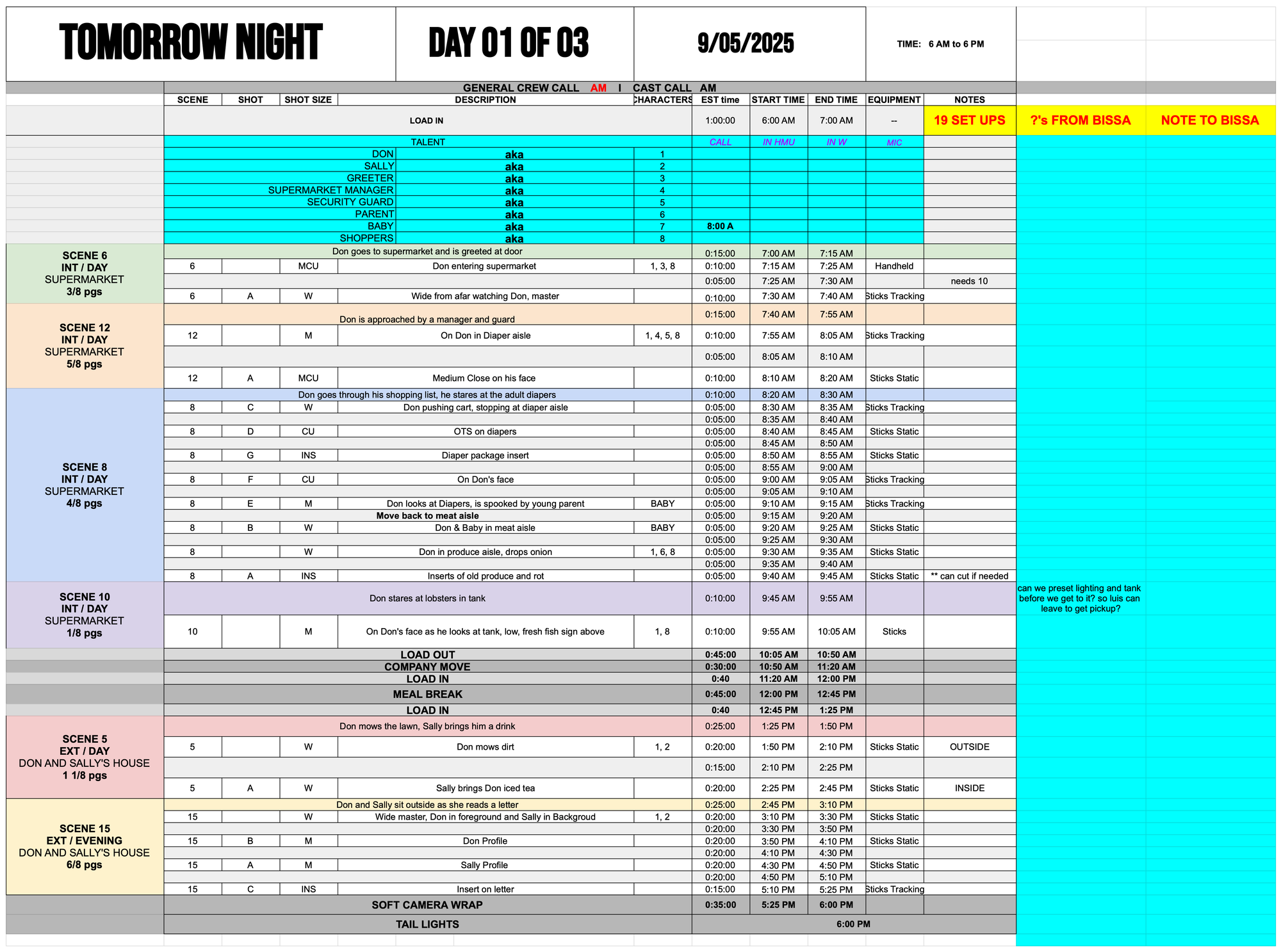
No problem, I thought. That's just the reality of production. The producers and I will find two days for the actors and I to rehearse before then.
But you can't rehearse until SAG approves your project. I could take my actors out for coffee and talk through it in detail (and I did), but scheduling a time for them to meet was verboten until we got SAG approval which, for us, came something like three days before we started shooting. This, we have been told, is normal, so plan for it.
Luckily my actors were long-time professionals who were still able to turn out wonderful performances. But they and I would discover problems with the scenes that could, and should, have been solved before cameras were rolling. Our time on set was spent finding their emotional logic, rather than having them already feel confident in that and just be able to play.
All that matters are your actors' performances. It doesn't matter what camera you have, or if you break the line, or whatever rules you're worried about – if you capture a great performance, the audience will forgive all your sins. Rehearsals are a big investment, but now I know they're the one that matters most.
4. Take your time in the editing room.
This one is the most nebulous, and requires the most caveats.
Some short films are cut together in a matter of hours, and some spend eternity on a hard drive, never assembled. If you have to be one of those two, then get it out quickly. For as often as I want to quietly scramble and lock away a project, something finished, even if it's not what you hoped it would be, is always better than something abandoned.
But I was so keen to get this short out for certain festival deadlines that I picture locked two months* after we wrapped, and I think I didn't let it fully cook.
I now see so many things I want to cut. There's so many different approaches to these scenes that I wish I'd explored. I never even tried assembling it in the order I initially imagined it, I just proposed changes and built off the editor's cut.
To be clear, my editor is fabulous, and what she assembled was often demonstrably better than what I had imagined. It's so important to have that outside eye saying, "you don't need this," or "that doesn't make sense." Your editor is the only person – other than you and your producers – whose job is to make sure this whole thing works. Also, your editor's time is valuable; being decisive is being respectful, and you don't have the budget for them to be cutting this mess for a year.
And yet.
I also know that had I given it some time to breathe, and given myself a little bit of distance, I would have been able to approach the edit with clearer eyes. They say a movie is written three times – on the page, on set, and in the editing room – and by moving too quickly through post-production, I didn't allow myself to be that third writer I needed to be.
While it's great to have goals and deadlines, the truth is no one's waiting for your short, so there's no reason to rush it out. It doesn't have to be perfect, but try to make sure it's the best version of what it can be – and in the absence of money, that just takes time.
5. Pick a better title.
Once I started showing early cuts to people, a consistent note (particularly from professionals) was, "You gotta change that title."
Tomorrow Night, they said, was vague. It didn't set an expectation, didn't create any excitement. I disagreed – I saw it articulating our lead's anxiety of what the next night would bring, and the idea that this is just on the horizon for everybody (It could happen to youuuuu!!!) – but the note was frequent enough that I took it seriously.
My producers and I set aside a few hours to try to find a new title. We pitched without judgement, no bad ideas, and wrote everything down. But in the end, everything felt too garish or bland. All three of us liked the original title, and decided to push forward as Tomorrow Night.
We should have taken the note.
Let's say we called it Old Grandma Pee-Pants. That's an obnoxious title that is totally wrong for the tone of the movie. But when you're looking at an ocean of 11,480 short films, Old Grandma Pee-Pants stands out. It makes you stop and say, "What is THAT?"
Festival programers don't care if your title is classy and thoughtful. They want a title that people are going to look at and say, "I want to see whatever that movie is." And when your short inevitably ends up online, you're going to want an eye-catching title for the exact same reasons.
Natalie Musteata and Alexandre Singh, who won the Oscar this year for their short Two People Exchanging Saliva, said on Scriptnotes:
"Probably the best thing we did in this entire process was choosing the title of our film, because choosing the title of a film costs you zero, nothing. Do not dull the edges. Be a bit spikey."
Heed the Oscar winners' advice.
For what it's worth.
noun, UK informal disapproving
/ˈwɪndʒ.ɪŋ/
continuous complaining, especially about something that does not seem important.
Despite the previous 2,800 words bemoaning the fate of my short film, I am aware of my immense privilege here. Most people have to eat their flop privately, whereas I can use this platform as an excuse to dissect my work and maybe get a few people to watch it. This is not altruism, it's just more marketing.
I want to be honest about this because if you also have a flop on your hands, I have one last observation – one that I think is maybe the most important thing I've learned, but it will also be wildly hypocritical, so it's important for me to empty my pockets, so-to-speak, so you know this is coming from somewhere genuine and not wildly out of touch:
Don’t tell anyone you failed.
No one really cares about your short other than you. All they can see is that you made something. So shutting up about your flop is the best thing you can do.
That said, don’t lie. You may owe explanations to your donors, your cast and your crew. Those might be tough conversations, and you should be unflinchingly honest with them.
But if someone asks you what's going on with your short film, you can just say, "It's great, thanks. We're out to festivals. I love how it turned out." It may not be how you feel inside, but it's a white lie that will help you immensely in the long run.
You may also feel an impulse to get ahead of any criticism and preemptively apologize for any shortcomings every time you share your movie. Stop that.
Calling your film a failure makes people see your film as a failure, whereas sharing it without apologies just makes it exist. Let people draw their own conclusions, and you’ll be shocked by what people find moving in your work.
Because the truth – the real truth – is that you didn't fail.
I know that sounds like a treacly rationalization, but after sitting with all this, I think it's the only conclusion.
Failure would be not making your short. And that happens far more often. Everyone has a million unrealized projects, but very few actually get made because making movies is hard.
Your movie shouldn't exist. It is not natural or inevitable. But now it does. That alone is a massive success.
I also try to make a personal goal for each project, so even if the whole thing falls apart, I'll still grow. I went into this short never having worked with a big crew before, and wanted to see if I could handle that pressure. And my incredible, talented, immaculate crew ensured that I succeeded in that. No matter how the short performs, I know I've found my team. If your project led to personal, professional or artistic growth, then it is a success.
Success feels like a scoreboard. If I'm looking at festival rejections, I lost 22-1. But even though some parts of it are quantifiable, the better analogy for success might be a stock chart – you're going to have dips, but as long as you keep making stuff, it'll probably trend upwards. Hopefully. Maybe it just has the potential to. But you definitely can't succeed until you make the next thing.
So go ahead, touch the stove. It'll be different this time.
Post-Credits Scene
*Yes, two months seems like a long time. But we have full-time jobs, this was just something we worked on on the weekends, which time-wise is the equivalent of about eight days.