Things I learned playing Fire Emblem: Fortune's Weave
We're justifying over 300 hours of gameplay by breaking down some of the ways Fortune's Weave tells its story, and what writers can pick up on from this game.

A Tactical RPG may seem like a digression from our usual content, but there's plenty of storytelling knowledge to pull from this well-executed (and very long) game.
Let’s take a trip to the continent of Dagda for a closer look at how a story meant to drive gameplay uses tactics suited to other narrative styles.
Introducing characters through desires
There’s a Tournament of Heroes in Dagsion, the capital of the Dagdan empire. The tournament’s winner will be granted one wish from the Divine Sovereign, Solel.
There’s two parts to the setup: The Structure and The Hook. We’ll come back to the structure, but let’s focus on the hook.
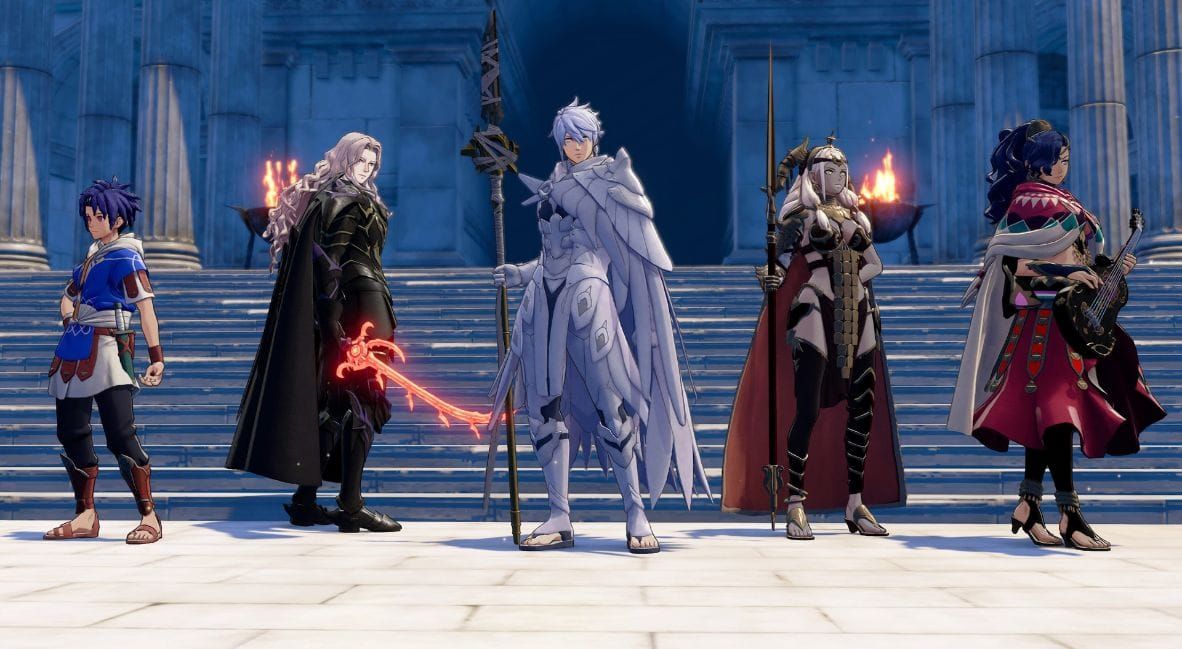
Since this story has four co-protagonists, they each have their own wish and introduction:
- Cai is a teenager who just learned his absent mother is a literal goddess (and daughter of the Divine Sovereign), and his father’s about to be executed for the crime of eloping with her. Cai’s wish is a pardon for his father and the chance to actually live with his parents now that he knows the truth.
- Theodora is the Queen of Saramis, a territory of the Dagdan empire whose people are descended from the people Dagda the Great attempted to purge from the continent generations ago. Her wish is greater independence for her people and the restoration of the temples of their patron goddess, Yu Phas.
- Leda is the daughter of an assassinated noble who has traveled the land killing the people who plotted her father’s murder (and playing a haunted guitar). Her wish is to have the man who killed her father released from Dagsion’s prison so she can kill him herself.
- Dietrich is... excedingly goth. He’s got a glowing sword inherited from his ancestors, and travels to find enemies that seem strong enough to make for an interesting fight. This Hot-Topic-Kraven-the-Hunter begins with the wish to fight a sea monster, but he ends up asking to go one-on-one with Mars, the god of war.
Making the prize something that the winner gets to choose, instead of a generic title or riches, gives the opportunity to explain who each contestant is based on what they want.
Characters also meet each other
Since the co-protagonists are also entered in the tournament, there are two phases to their interactions. Earlier rounds of the tournament offer team-ups between competitors, where these four are forced to fight alongside each other. Later rounds separate them out, pitting them against each other for the big prize.
Inherently, their goals are mutually exclusive by nature of the contest having a single winner.
There’s tension created when an ally that a character finds common ground with is suddenly an enemy.
Victory has a cost
Cai, being the youngest and least initially murderous of the four, feels this very acutely as he reasons out that he can’t stop fighting to free his father, but he knows what his victory would mean for Theodora and Leda.
And all four of them have a weapon that gives them an advantage in the tournament, but threatens to either consume their mind and control them or physically transform them. Dietrich’s sword begins to change him into a demonic beast in his final battle of the tournament as he gives himself over to mindless, animal bloodlust.
For a protagonist, there’s an exchange that needs to happen to earn a victory. It’s a bill paid in effort, pain, danger, or sometimes all three. The path to victory tests the endurance and resolve inside the character at the same time they’re overcoming the external obstacles.
The stakes set the pace
The game itself is separated into three acts.
Act One centers on the tournament, and sets the pace of gameplay around a calendar. There’s time between each match for characters to explore, train, test out new skills, or get more clues to the story unfolding in the background.
It’s fairly open-ended and gives time to learn how the game works and who each of the characters are.
But after the tournament comes Act Two: The War.
Within minutes of starting this segment, Dagda the Great has returned, removed his son from the throne, and begun his plan to finish what he started generations ago by killing all of the people of Saramis.
Instead of having long stretches of time to roam around like before, gameplay condenses to a quick setup section, followed by the next major battle of the war.
The urgency of the stakes sets the pacing for the story.
Act One gives room for the characters to breathe and for the audience to get attached to them. Act Two doesn’t have time for that, because everyone has a common goal of stopping a god emperor from committing genocide.
Changing stakes can change relationships
The co-protagonists joining forces for the war makes sense in part because of how the audience sees them work together earlier in the tournament.
By having the characters connect with each other as both allies and rivals in a competition, instead of just enemies, it makes the shift to comrades-in-arms less jarring.
But even though there are four co-protagonists, they’re not all equal at this point.
Theodora takes the lead. She’s the queen of the nation Dagda declared war on. She specifically requests the other three to join her and help the fight. And while every person on the continent is threatened by an unhinged emperor, Theodora has the most clearly painted target on her back.
As the story condenses around a single desire, one character acts as the focal point instead of all four.
Emotional connection makes the difference
A movie or TV show can have dazzling cinematography, a great soundtrack, or a dozen other trailer-worthy elements. An epic game like this can have deep character-building mechanics, layers of strategy, and inventive battlefield design.
But the story holds it together.
With a game like this, if you don't get invested in the characters and their drama, they're just spreadsheet data you use to reach a goal. The difference between push-button-get-reward and getting emotionally attached to what your doing is imperative to keeping a game interesting. It's the same thing with stories we read or watch.
Each of those little clusters of polygons on the screen has a backstory, relationships with other characters, and unique skills. This isn't chess.
And it's the same with any story. A hero blasting through an army of cardboard-cutout strength henchpeople won't hold a candle to a chase between rivals, or former allies finally reaching a long-simmering death match.
We care because we see they care.