How Many Acts Does a Screenplay Have?


Ask ten screenwriters how many acts a screenplay has and you'll get a range of answers — three, four, five, depending on who you're talking to and whether they're writing film or television. The honest answer is that it depends entirely on format.
Here's how acts actually work across film and television.
- How Many Acts Does a Movie Have?
- How Many Pages Should Each Act Be?
- How Many Acts Does a TV Show Have?
- Does Act Structure Matter?
- Screenplay Acts: Frequently Asked Questions
How Many Acts Does a Movie Have?
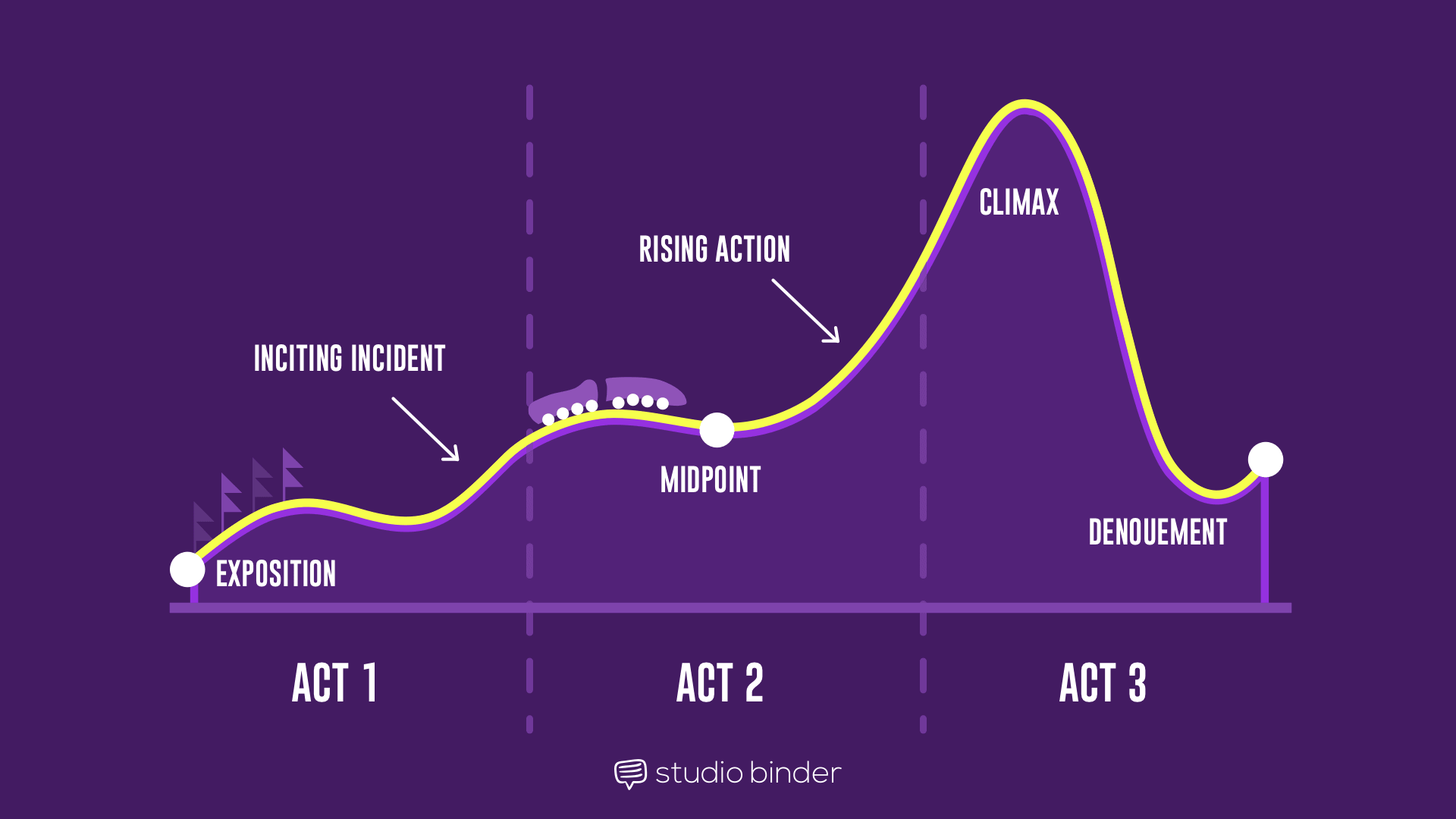
Feature film screenplays are generally said to have three acts. But unlike a stage play — where act breaks are explicitly written into the script and the house lights go up between them — feature screenplays almost never include act break indicators on the page. An act in a screenplay is really a theoretical concept. Screenwriters talk about three acts meaning the beginning, the middle, and the end. Nothing more formal than that.
In practice, most working screenwriters think in terms of four movements rather than three, following what's commonly called the Syd Field paradigm: Act 1, Act 2A, Act 2B, and Act 3. The second act gets split in half because it's by far the longest section of any screenplay and the hardest to sustain. A midpoint shift around the middle of the script gives writers a structural anchor to write toward and away from. Even screenwriters who have never read Syd Field, and many who dismiss his approach entirely, tend to use this vocabulary because it's so pervasive in development conversations.
It's worth being clear: none of this is prescriptive. Acts are a tool for talking about structure, not a template you're obligated to fill. Plenty of great screenplays don't map cleanly onto any act model. The value of thinking in acts is that it gives you a shared language for diagnosing problems ("the second act sags," "the turn into act three isn't earned") not a formula for building stories.
How Many Pages Should Each Act Be?
If a feature screenplay runs approximately 100 to 120 pages, the rough page distribution across three acts tends to look like this:
Act 1 — approximately 25 to 30 pages. This is where you establish your world, your protagonist, and the central problem or question the story is going to explore. By the end of the first act, something should have changed that commits your protagonist to the journey ahead.
Act 2 — approximately 55 to 65 pages, often divided into 2A and 2B with a significant midpoint event separating them. This is where the bulk of the story lives: complications, reversals, escalating stakes, and the gradual dismantling of whatever your protagonist thought would solve their problem. The end of Act 2 is typically the lowest point. Things have gone as wrong as they can go before the final push.
Act 3 — approximately 25 to 30 pages. The resolution. Your protagonist confronts the central problem with whatever they've learned over the course of the story.
These are rough guidelines, not rules. A tightly constructed thriller might have a first act that ends at page 20. A character-driven drama might not hit its act two turn until page 40. What matters is that the structural beats are there and feel earned, not that they land on a specific page.
For a more specific breakdown of why acts tend to actually do the things we generically claim they do, watch this video about how Craig Mazin writes a movie:
How Many Acts Does a TV Show Have?
Television is more explicit about act structure than film because TV acts have a practical function: they're where the commercial breaks go. An act break in a television script is a genuine structural marker, written into the script, designed to end on a moment that makes the audience stay through the commercials.
The number of acts varies significantly by format:
Hour-long dramas typically run five to six acts, often with a cold open before Act 1. The cold open (sometimes called a teaser) is a short scene before the title card that either sets up the episode's central problem directly or hooks the audience with something unexpected. Some shows use it as a standalone vignette with no direct plot connection to the episode. Act breaks in hour-long dramas are written explicitly into the script, usually indicated with END OF ACT ONE, ACT TWO, and so on.
Half-hour single-camera comedies typically have two to three acts between a cold open and a tag. The tag is the short scene after the main story wraps — usually a beat that pays off an earlier joke, resolves a minor subplot, or simply gives the episode a final laugh before the credits roll.
Half-hour multicamera comedies traditionally run two acts with a cold open and tag, though this varies by show. Multicamera scripts look quite different from single-camera scripts on the page — act breaks are prominent structural dividers, scenes are numbered, and the format is more theatrical in nature.
Streaming series have complicated this picture considerably. Many prestige streaming dramas don't write traditional act breaks into their scripts at all, functioning more like feature films in their structural approach. If you're writing a spec for a streaming show, read several scripts from that specific series to understand how it uses act structure.
One important note: if you're writing a spec episode of an existing show, the act structure of your script should match the show's. A drama that runs five acts expects five acts in its specs. This is one of the first things a reader familiar with the show will notice.
Does Act Structure Matter?
Act structure is a description of what good stories tend to do, not a prescription for how to build them. The writers who get into trouble with three-act structure are usually the ones treating it as a checklist — forcing a plot point at page 25 because the paradigm says so, whether or not the story needs it there.
The more useful way to think about acts is as a diagnostic tool. When a script isn't working and you can't immediately identify why, asking structural questions (where does Act 1 end? Does Act 2 have a clear midpoint shift? Is the Act 3 turn earned?) can help you locate the problem quickly. Acts give you a vocabulary for the conversation, not a blueprint for the work.
As for the general shape of all stories, Kurt Vonnegut has some choice words and some helpful scribbles:
Screenplay Acts: Frequently Asked Questions
Do feature film screenplays include act breaks on the page?
Almost never. Unlike television scripts, feature screenplays don't print act breaks. Acts in film are a theoretical framework used in conversation and development not a formatting element. If you wrote ACT TWO in the middle of your feature spec, readers would find it unusual.
What is the difference between a cold open and Act 1?
A cold open (also called a teaser) is a short scene or sequence before the title card and before Act 1 officially begins. It's common in television and film. The cold open might set up the episode's central theme tone, or conflict directly; or it might be entirely standalone.
What is a midpoint and does every screenplay need one?
A midpoint is a significant structural event roughly in the middle of Act 2 that shifts the story's direction, raises the stakes, or reframes what the protagonist is actually up against. Not every screenplay needs a textbook midpoint, but most benefit from some kind of significant beat in the middle of the second act to prevent the story from losing momentum. It's a useful tool, not a requirement.
How many acts does a pilot script have?
It depends entirely on the type of show. A single-camera drama pilot typically follows the same act structure as the show it's launching — usually five acts with a cold open. A single-camera comedy pilot usually has two or three acts. A streaming pilot might have no explicit act breaks at all. Before writing a pilot, decide what kind of show it is and format accordingly.
Can a screenplay have more than three acts?
Yes. Five-act structure exists and is used by some writers, particularly those drawing on classical dramatic theory. In television, five and six acts are the norm for hour-long dramas. In feature film, the number of acts is less important than whether the story has clear structural momentum — setup, complication, escalation, and resolution — however you choose to divide it.