Scriptnotes Recap: Ep. 743 - Thinking on Your Feet with Ryan Condal
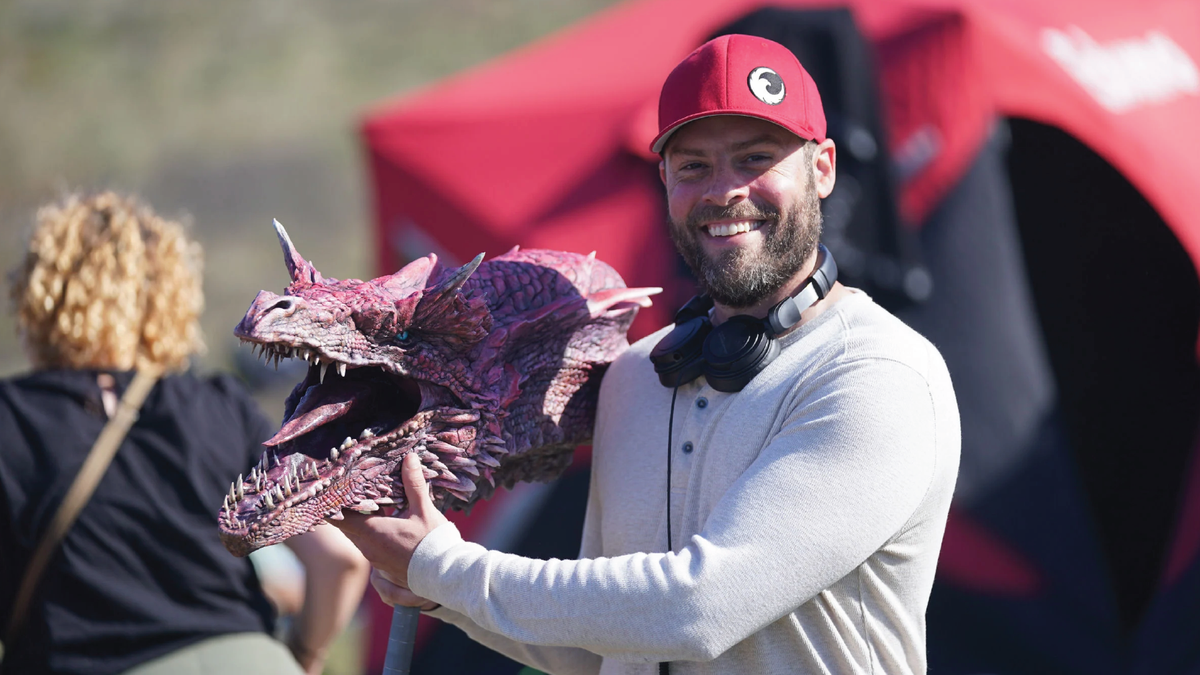
What inspires me most about Ryan Condal’s path to showrunning? Well, he really put in the work. And now, he’s at the helm of one of the most successful franchises ever: the Game of Thrones prequel, House of the Dragon.
While Ryan was trying to break into the industry, his day-to-day was less about dragons and more about… pharmaceutical sales. He worked in advertising by day, but at night, he wrote furiously. He even asked to get transferred to an L.A. office so that he could be closer to his dream career. And like everybody hopes, it eventually paid off. Big time.
Now, he’s got numerous movies and series under his belt. In his conversation with John and Craig, they talk about his unconventional beginnings, staffing writers rooms, and of course... DRAGONS.
Advertising, Specs, and the Long Road to Television
John: Ryan Condal is the co-creator and showrunner of House of the Dragon, which has just started its third season on HBO. You went into the industry through a different route — you didn't show up in Los Angeles at 21 and PA on a set.
Ryan: I was working in marketing and advertising. I'd always wanted to be a screenwriter. I was the weird kid that knew I wanted to be a professional writer when I was 12 or 13. Then I had a really great humanities teacher in high school who taught us three-act structure. He broke down Star Wars and taught us the Joseph Campbell hero's journey thing alongside it. It just broke my brain because I was such a huge movie fan. I thought it was the directors and the actors making it all up and didn't realize there was a craft involved. Then I was like, "Forget novels. This is exactly what I want to do."
I had a business degree, so I worked in media advertising, then pharmaceutical advertising. I wrote at night and then eventually got my company to move me to LA. I kept writing at night. Eventually, number 13, my 13th spec, I sold just after the 2007 Writers' Strike.
Craig: I was doing the same thing — copywriting for a company that made promos for CBS shows. One thing that advertising taught was concision. They said you have 30 seconds, really 28.2 seconds, to tell a story, beginning, middle, and end with a point, and it has to somehow stick in people's heads. Curious if you still feel that, the siren call of the concision of advertising.
Ryan: For sure. I worked in specifically print advertising. I was doing direct-to-doctor advertising, this highly technical, science-driven stuff. It's matching words to images in a way that they work in harmony, but it's not saying the same thing. You're not showing people a picture and then saying what the picture is. It's lateral thinking to try to tell a whole story in a still image and arrest people and stop them as they're flipping through their medical journal.
I also had to go out and pitch clients who didn't necessarily want you. That experience set me up in a way that I didn't even realize until I went into my first pitch. You sell a spec, you work your whole life to write something that people want to buy, and then you do it. Then the next job you get, you have to do this entirely different skill that you haven't learned. Then it's actually contrary to everything that makes you want to be a writer, where you want to sit in a room by yourself and not have to talk to anybody.
John: I loved the precision copywriting and recognizing who your audience is, what are they expecting, how do you surprise them. Also, you're working with a team — the art director, the creative director, the account executive, the client — and there are clear parallels to everything we deal with. Here's the studio, here's the director, here's the producers. Making sure they all feel heard, but also that the thing you're delivering is the best work possible.
Running a Room: Samples, Draft Writers, and the Senior Partner
Craig: Talk me through building a room and running a room and how your vision as a showrunner interacts with the material as you go.
Ryan: I just went out looking for the best samples I could find. I was reading plays. I was reading a lot of features, TV pilots, basically all original material. At the beginning, I was like, "This is my job and I have to read it until page 58." Now it's much more just looking to be hooked and have somebody convince you to stay on from page 5 and then page 10, the way a studio would go through reading a submission.
I'm just looking for somebody that can write and that can surprise you and delight you and deliver complex ideas in a simple way, write great characters, write interesting scenes. You need a bunch of people in the room that can break story and be tireless in just pitching. Then you need a few draft writers. In most cases, you're going to want to go in and put it in the voice of the show.
To the TV writers out there trying to do this for a job — you can be the lowest person on the totem pole, and in that first draft, you can be a hero to the showrunner. All we want is somebody to deliver that thing that needs a little polish. Better if you can take the notes and make it better. Then you're like, we'll put a cape on you.
Craig: The story of showrunning is you're surrounded by thousands of people who are desperate to help you, and almost all of them are hurting you. They don't even know it. They're trying. When you find somebody who helps, you cling to that person.
Ryan: Do not let go. I had this wonderful writer I worked with on Colony, Wes Tooke. He was the most senior-level person in season 1 and then just became my writing partner throughout. On House of the Dragon, it's Sarah Hess, whose first job was on Deadwood with David Milch. She worked on House and Orange Is the New Black. For me, once I had that, then everything else is a bonus.
We're all in person. I can't do that virtual stuff. I drift off. I can have a meeting on Zoom, like a story meeting, but I can't break story on it. We were old school — corkboard and cards. I like the physical satisfaction of finishing an episode and being able to put all those cards together in a neat little binder stack and taking them off and putting them on and moving them around on the board.
John: What would be on a card?
Ryan: It's usually beats, but a beat usually is a scene. Because you want to be able to read it from wherever you're sitting in the room. The writer's assistant keeps all of them cataloged, then writes all the bullets informing the scene beneath it. When the writer sits down with the outline, they know basically all the slug lines going into the script, the order that they're going in. This is where the scene begins. These are who are in it. This is where it ends. This is the dramatic experience we're taking the audience through. This is whose POV it is.
John: How long is the outline that the writer goes off with?
Ryan: Maybe six, seven, eight pages. Then they come back with a 10- to 13-page Microsoft Word prose — putting flesh on the skeleton. That's a layer of flesh. Then the first draft is a layer of flesh. Then you just keep doing concentric circles of detail.
Ryan: I just try for as much a kind honesty as possible. I think there are showrunners that don't address rewrites at all, and then that's weird. I think there are people that soft-shoe it, and then the writer reads the draft and there's not a line in it that they've written. I just try to have an honest conversation. "Look, it's a very specific world. It's a very specific syntax. I'm weird and specific myself. This is what I had to do. Read it. If you want to talk about it, we can talk about it." I always assure them, "This does not mean that you are not a great writer. That's why I hired you."
Movement, Setting, and How Characters Think on Their Feet
John: Watching your show over three seasons, you never have characters sitting down. Characters are always on their feet. People are always moving. I want to talk about character movement, but also how character movement relates to characters thinking and making choices.
Ryan: I had never thought of it that way. I think it's probably my anxiety about being castle-bound. Because really, I've talked about this show as a gangster epic. The capo de capos dies — Viserys dies in the first season — and all of his capos are fighting, and they all happen to be family. They are bound to their castles a lot. I think it's probably my anxiety saying, "Well, we're castle-bound, so we should be on the move and on our feet."
One of the big reasons for that is the sets we've built. The Red Keep — everything but the throne room — you can move from room to room and film continuously. There's a lot of steadicam. There's a lot of walking where somebody doesn't leave the room and you have to cut to bring them into the next room. You follow them out, and it creates this sense of movement.
Craig: I find where two people are sitting — and I love a good sitting-down scene — there's always some micro movement happening. When you're standing, there is always the implication we might have to turn around, run, and start killing people immediately, and I like that.
John: There's a scene I was working on yesterday where, because of stuff moving around in the script, I needed to move it from a sitting scene to a location where it was not going to be possible to sit. It's largely the same dialogue, but it feels so different to have the characters on their feet and moving around during the scene.
Ryan: In our sitting council scenes, when everybody is sitting, you can create movement in the edit by having the overlapping dialogue where you're not watching the person talking. You're watching the reaction somebody else is making. Daemon's ranting about something, but it's not necessarily what he's ranting about. It's how the other people are side-eyeing each other. You can take those big static stage scenes and bring a lot of life and movement and energy into them that way.
Craig: I like to remind myself of that when I'm shooting the first wide. It's like, "Well, this is a school play." It's like, "Okay, it'll get better."
Solving the Dragon Math
John: You have a lot more dragons than the original show, and we've learned a lot more about their individual personalities. Some of them are very feral. Some of them are much bigger. Talk to us about how you think about a world that has dragons in it.
Ryan: What is unique about our show is that dragons are an existing part of the ecosystem. There's a dragon economy, dragon infrastructure. That was really fun to design. There's a dragon pit, a dragon mount, these structures built to house them. There are dragon keepers — a monastic order of people who take care of them. There are saddles, which Daenerys never had.
We went into incredible levels of detail. How do you mount a saddle to a dragon? With the reins, you're not putting a bit in the dragon's mouth to steer them, so how are you steering? We crafted this whole story where when they're very young, born in captivity, they have hardware surgically implanted to mount the saddles and steering implements. Their armor heals around it as they grow. When you pull on it, they learn that means go right or go left or dive. A wild dragon like Sheepstealer doesn't have those implements, so he doesn't have a saddle. He's ridden bareback.
Craig: They are so all-powerful. There's a lot of dragon math going on all the time. Why can't this problem just be solved with a dragon?
Ryan: That's the thing you're sitting there staring at sometimes. We try to keep it really real. Our executive producer-writer David Hancock referred to them in Season 2 as big stinky war planes. They need fuel, so they need to eat. We had this thread in Season 2 where some of the pressures of the war are actually caused by the dragons because now that they're really active, they need more sheep and goats and cows, which means the people don't have those to eat. They were being requisitioned by the crown.
Vhagar is so big that she can't even fit in the dragon pit anymore. She's outgrown even the crazy-sized human structures we've built. The dragons can be really confounding to the writers because restraint in the use of them makes narrative sense, but you have to earn it. Every time you use a dragon to solve a problem, you are telling the audience, "We can do this." You want to preserve the right to be awesome. When a dragon shows up and just obliterates everybody — you love those moments, but every time you use one of those, you're shrinking the impact.
Ryan: Then there's the Gullet. We talked about production methodology for months, going into it, with director Loni Peristere. He ended up making what we called the Supercut — a really fancy animatic, pre-animation storyboards cut almost like a Ken Burns documentary with movement put into the storyboard. Sometimes it was just slug lines from the script, just to understand the structure of the battle. Then we actually edited the sequence before we ever even made it with this multimedia thing, and shared the Supercut with all of the crew so that everybody knew what we were making. We actually found a whole bunch of things — the individual ideas work, but how are we intercutting all of this so it feels like you're building and building and building?
I went into filming that sequence in a total state of terror because we spent so much money on it, and everybody was waiting for it, and so much was riding on it. I knew what it was going to be in the end, and I could see it. I just knew that as long as it's in the little video monitor, we have it and we can go make this thing.
Craig: It comes back to the script. If it's just empty spectacle — you tried to put as much drama, tension, emotion into it. You did. It was emotional.
Ryan: That's the key of the thing. It all comes back to the script.
Listen to the full episode on Scriptnotes or wherever you get your podcasts! The full transcript is available at johnaugust.com