🪞 #294 - Don't Fear the Symmetry
What happens when you show how much opposing characters have in common? How can "two sides of the same coin" add depth to a story?

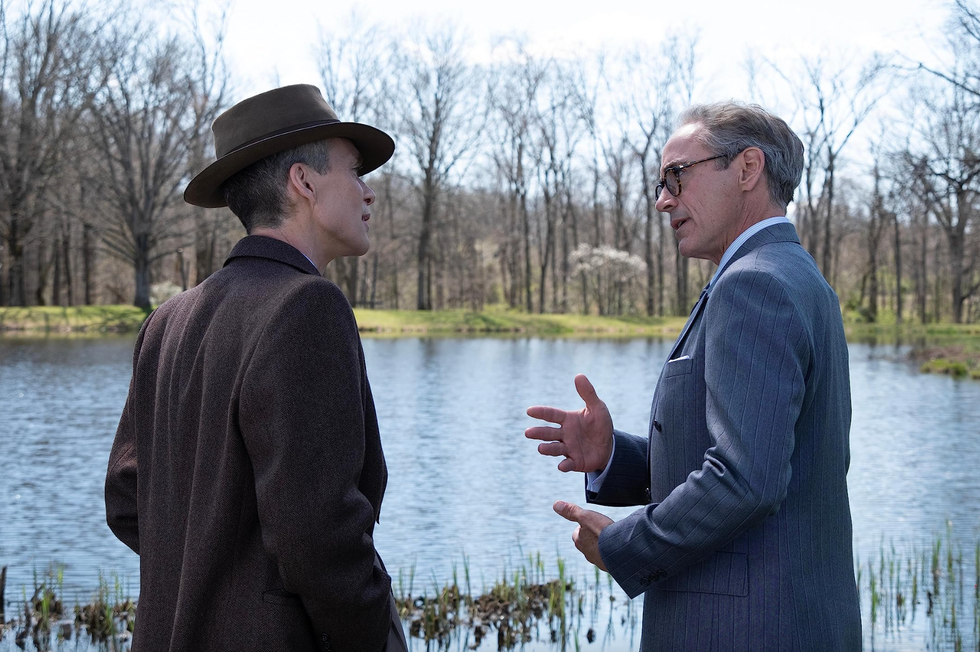
About two-thirds of the way through American Prometheus, there's a reference to the Senate confirmation hearings that Lewis Strauss, ultimately the antagonist, was subjected to. I immediately grabbed that and went, Oh, there's a really interesting relationship between what he had done to Oppenheimer and then what was done to him. As a writer, you're always looking for those kind of poetic echoes, those kind of rhyming relationships in narrative. I chased that down.
For example, I started to realize, while reading the objections in the Oppenheimer transcript-which is about a thousand pages-I found things like Oppenheimer and his lawyers strongly objecting to the fact they had no list of witnesses. Strauss in the congressional testimony is making the same complaint, that they're not giving him a list of witnesses. Things like that, that as a writer, you're like, "This is such a gift."
Christopher Nolan in Scriptnotes
The skin-deep version of this idea is the antagonist sizing up the protagonist and saying, "We're not so different, you and I." Beyond the irony of a protagonist and antagonist having things in common, showing symmetry between what seem like completely opposed characters can draw an audience's attention to larger themes, or explore what it is that draws the line to differentiate two character types.
Looking at another Nolan film, Poggy dissects the way Interstellar uses a poem to establish symmetry between two of its characters. The echo shows how deep the deception about the mission went, and just how many of the other characters had no idea that the mission's Plan B was designed as the only serious option.
Sight Unsound shows how the trajectories of Rust and Marty in True Detective show symmetry between these initially opposed investigators as they each change and take on characteristics of each other.
Movies I Love (and so can you) goes on a deep, bring-an-air-tank dive into Blade Runner and Blade Runner 2049 to focus on how the central philosophical question of both films lies in the uncomfortable symmetry between humans and replicants. Tests to determine if someone is actually a replicant become more rigorous, suggesting a narrowing gap between the two groups. Meanwhile Podcast focuses on the first film, examining how the problems the replicants face are an exaggerated representation of similar problems facing humans: an uncertain lifespan, an unclear sense of purpose, and a lack of control over their lives. And Flick Fanatics argues that Blade Runner 2049 shows replicants gaining more human characteristics as humans show an opposite trajectory, losing their humanity.
These examples help highlight an idea: symmetry in storytelling isn't just about single moments of mirroring, but how changes highlight similarities. Just like how character relationships grow and change over a story's progression, characters can also become more or less similar as the plot unfolds.
👋 Are you new here?
Inneresting is a weekly newsletter about writing and things that are interesting to writers. Subscribe now to get more Inneresting things sent to your inbox.
And if you can't wait until next week for more Inneresting, check out the Quote-Unquote Apps Blog where we keep previous issues and other posts about screenwriting and things interesting to screenwriters.
In case you missed it...
In the most clicked link from our last issue, Jonathan W. Stokes covers ways to make your audience invest in your hero.
What else is Inneresting?
- When is pinball not pinball? Youtube channel I am the dot suggests that the answer is absurdly nuanced.
- Nandini Maharaj wants you to know that the impulse to lie on the floor when you're overwhelmed is actually healthy.
- Tawny Platis analyzes how the vocal performances of actors in The Boys each display a relationship to tropes of manufactured masculinity (and how Frenchie is the only truly secure man out of all of them).
And that’s what’s inneresting this week!
Inneresting is edited by Chris Csont, with contributions from readers like you and the entire Quote-Unquote team.
Are you enjoying this newsletter?
📧 Forward it to a friend and suggest they check it out.
🔗 Share a link to this post on social media.
🗣 Have ideas for future topics (or just want to say hello)? Reach out to Chris via email at inneresting@johnaugust.com, Bluesky @ccsont.bsky.social, or Mastodon @ccsont@mastodon.art
The Tyger
by William Blake
Tyger Tyger burning bright,
In the forests of the night;
What immortal hand or eye,
Could frame thy fearful symmetry?
In what distant deeps or skies.
Burnt the fire of thine eyes?
On what wings dare he aspire?
What the hand, dare seize the fire?
And what shoulder, & what art,
Could twist the sinews of thy heart?
And when thy heart began to beat,
What dread hand? & what dread feet?
What the hammer? what the chain,
In what furnace was thy brain?
What the anvil? what dread grasp,
Dare its deadly terrors clasp!
When the stars threw down their spears
And water’d heaven with their tears:
Did he smile his work to see?
Did he who made the Lamb make thee?
Tyger Tyger burning bright,
In the forests of the night:
What immortal hand or eye,
Dare frame thy fearful symmetry?