Standard Screenplay Format: The Complete Writer’s Guide


The screenplay format is exacting and regimented. It can intimidate new writers and old pros alike because at some point all of your wonderful ideas need to be transformed into sluglines and action lines and dialogue.
But, before you start worrying about translating all of your ideas into screenplay format, it's helpful to master the basics and read as many professionally written and produced scripts as you can. Many industry professionals claim they can spot the difference between a professional and an amateur screenwriter within the first page of their writing, so mastering these elements is your first line of defense when presenting your work.
Quickstart Reference
- Font: 12-point Courier (or Courier Prime)
- Margins: 1.5" left, 1" right and bottom
- Length: ~1 page = 1 minute of screen time
- Core elements: Scene heading, action lines, character name, dialogue
- The Rules at a Glance
- The Basic Elements
- Scene Headings
- Action Lines
- Dialogue
- Transitions
- Frequently Asked Questions
The Rules at a Glance
Standard screenplay format is the set of margins, font, spacing, and layout rules that every professional film and television script follows. This guide covers every element of standard screenplay format from margins and fonts to scene headings, action lines, and dialogue.
While there can be slight variations for different types of scripts (ie multicam sitcom teleplays), screenplays follow strict formatting rules.
Fortunately, screenwriting software like Highland Pro, will do the heavy lifting for you and automatically format your screenplay. However, even with the help of dedicated programs, it can be helpful for beginners to study and internalize the rules, conventions and best practices.
Or, better yet, go give Scriptnotes: The Book a read!
The Basic Elements
- 12-point Courier font: Courier is a fixed-pitch font where every character takes identical horizontal space. This convention is largely an artifact (as are many screenplay formatting rules) of mechanical typewriters, however it also helps with readability and the mostly consistent 1-page-per-minute "rule" equation.
- 1.5 inch left margin: The extra margin accommodates the three-hole punch used to bind printed scripts with brass brads.
- 1 inch right margin (between .5 inches and 1.25 inches), ragged
- 1 inch top and bottom margins
- Approximately 55 lines per page, regardless of paper size (top and bottom margins adjusted accordingly). This does not include the page number, or spaces after it.
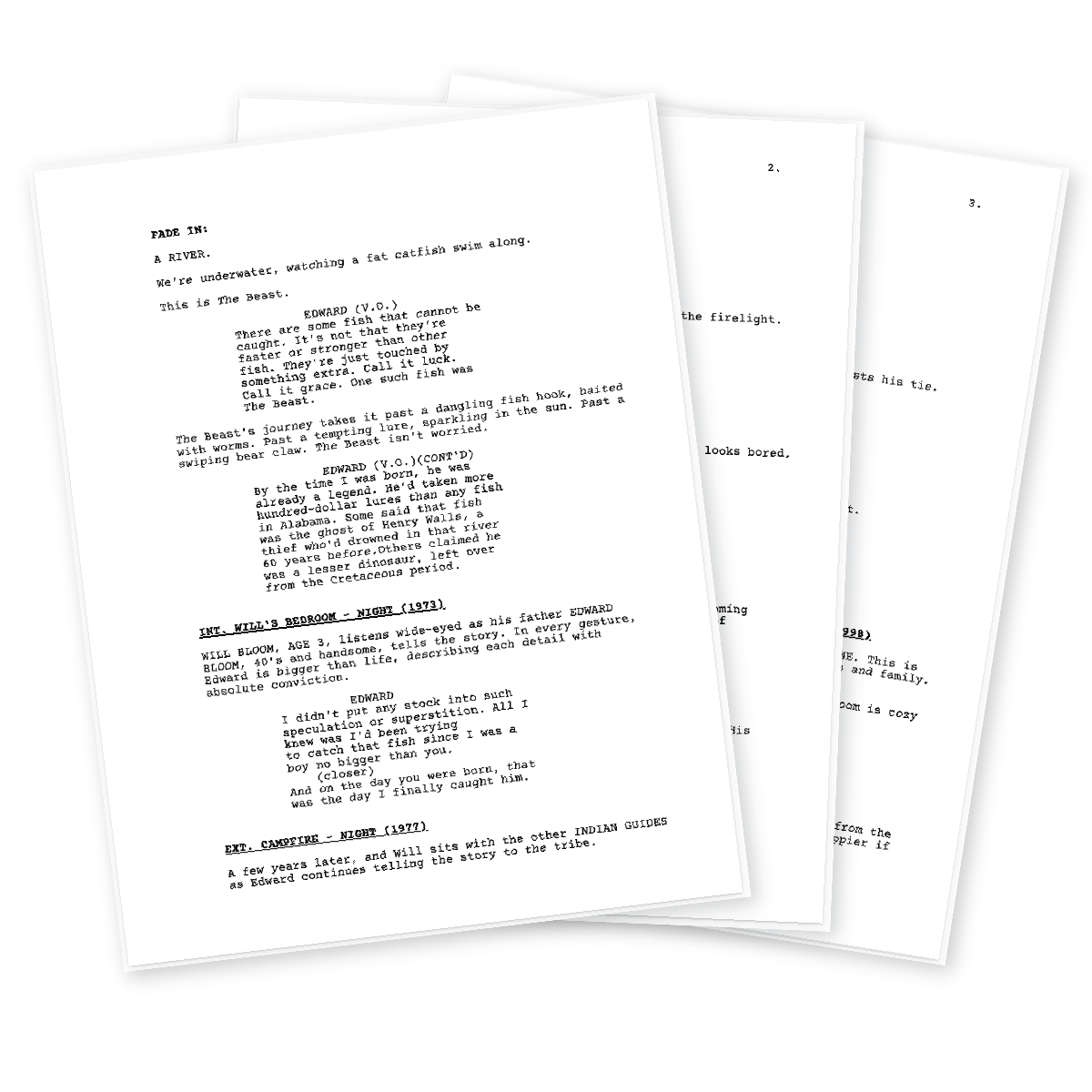
- Dialogue speaker names (in all caps) 3.7 inches from left side of page (2.2 from margin)
- Actor parentheticals (aka wrylies) 3.1 inches from left side of page (1.6 from margin)
- Dialogue 2.5 inches from left side of page (1.5 from margin)
- Pages should be numbered in the top right corner, flush to the right margin, a half-inch from the top of the page. The first page isn't numbered because readers assume they're on page 1. Numbering begins on page 2, the third physical sheet when you include the title page.
Scene Headings
Scenes and scene headings are really the building blocks of your screenplay. They help answer the fundamental question of what happens and where does it happen? Each scene heading is written in all caps and is formatted INT. or EXT. (interior or exterior) LOCATION NAME (Police Station etc) and closes with – TIME OF DAY (generally DAY or NIGHT).
INT. POLICE STATION - NIGHT
For a more detailed breakdown of scene heading rules and conventions, we have a full guide to scene headings with more detailed and varied examples.
Action Lines
Now that you have a scene heading, action lines are how you actually tell your story. We have a location and a time of day, now with action lines you can introduce characters and get into the beat-by-beat moments of the plot.
Action lines are generally written in the third person present tense in paragraphs of text that are 4 or fewer lines. Going longer than 4 lines regularly in a screenplay is typically a mark of amateurism as you are overloading the reader with details to the detriment of the narrative and dramatic pacing of your story. Remember, if your screenplay becomes a film or television show, there will be dozens of brilliant, creative people to help fill in the blanks. Your job as the writer is to present the most engaging and necessary elements of your narrative to convey the experience of viewing the movie to your reader – even though the movie only exists in your head at this stage.
There are many other rules of thumb people throw at writers like: never use we see or we hear; or, never write internal thoughts, only what the audience can see or hear. These rules are broken all the time by great screenwriters and can largely be ignored. If you ever have a question about what is or is not acceptable in a screenplay, go and read more professionally produced screenplays to see what rules contemporary writers bend, break, or outright ignore.
Dialogue
Dialogue is every word said by your characters aloud. It is demarcated by the character's name in ALL CAPS with the dialogue itself following directly after. There are ways to modify and clarify dialogue with voice-over and off-screen dialogue extensions – (V.O.) or (O.S.) in-line after the character name – or with parentheticals that go directly beneath the character name and can modify the way in which dialogue is performed or can inject action into the performance. (sarcastically) or (to herself) or (loudly) might alter the intended performance of a line while (juggling) or (cutting vegetables) or (opening a letter) adds action to the line.
But, as with all elements of a screenplay, try to use parentheticals infrequently as they can take up too much space on the page and can feel like you're micromanaging your actors. A good script conveys necessary information while leaving space for meaningful collaboration. Your intentions should be clear and legible without becoming didactic or dictatorial.
Transitions
Transitions are probably the least used standard element in modern screenwriting. Virtually every screenplay will open with FADE IN and end with CUT TO BLACK.
Transition are used less frequently than they used to be in older scripts. It is entirely unnecessary to use CUT TO every single time you move from one scene to another as it eats up page count and add unnecessary ink to the page. These types of transitions only need to be added if they're serving a specific function for the pace or the narrative like a SMASH CUT or MATCH CUT or DISSOLVE TO or CUT TO BLACK.
A more common tactic would be to use CUT TO within a scene when there is a marked shift in focus without a change of location. One could imagine cutting to a news report on tv during an alien invasion or an alarm clock or a characters reaction. This type of focus shift can be achieved through the use of language alone, but transitions can help really drive focus on the page which will help that focus land on the big screen.
Frequently Asked Questions
Does one page of a screenplay equal one minute of screen time?
Generally, yes — but only with correct standard screenplay format: 12-point Courier, proper margins, and ~55 lines per page. Action-heavy scripts often run shorter on screen; dialogue-heavy scripts are closer to the estimate. Think of it as a reliable production planning rule of thumb rather than a guarantee.
How long should a feature film screenplay be?
Most scripts run 90–120 pages. Going significantly over 120 signals the script needs tightening and will raise flags with readers and coverage analysts unless you are already a well-established screenwriter.
Can I use a font other than Courier?
For screenplays, no. Courier (or variants like Courier Prime or Courier New) is the industry standard. Using another font immediately marks a script as amateurish. When submitting to agents, managers, or competitions, use Courier 12-point.
Do I need screenwriting software, or can I use Word?
While Word and Google Docs can approximate screenplay format, they require constant manual vigilance over margins, tabs, and spacing. The hassle is almost never worth it and the results are almost always noticeably worse. Dedicated software — Highland Pro, Final Draft, Fade In — handles all of the formatting automatically. For anyone writing more than one script, the time savings alone justify the switch.
Is screenplay format different for TV pilots vs. feature films?
Single-camera drama pilots use the same format as features. Multi-camera sitcom scripts use a completely different format: double-spaced dialogue, numbered scenes, all-caps action. Identify your show type before you start — the format choice immediately signals genre and production intent to any reader.
Read more professional screenplays with Weekend Read:
Weekend Read 2 makes it easy to import your own files, or discover something new in our curated, weekly screenplay collections.
Supplemental Links:
Examples of properly formatted screenplays can be found in the johnaugust.com library.