Why you make them fight back
A writer can't insert a bully getting their comeuppance into a story and expect the audience to immediately cheer for the underdog. When does fighting back help satisfy a larger character goal, and when does it cause more complications to overcome?

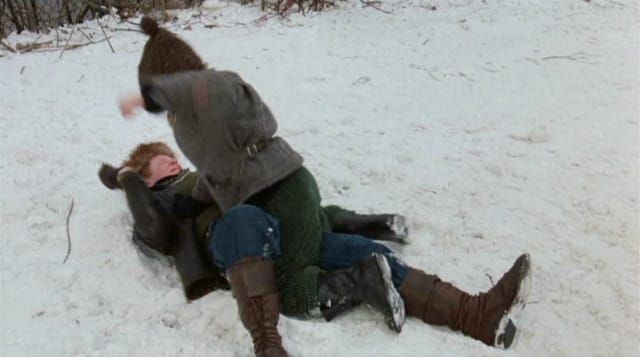
Audiences love to cheer for an underdog. Right?
So all it takes to get some enthusiasm from a crowd is to show them a bully who gets a taste of their own medicine?
It's more complicated than that. And not only because there might be people who are more ready to identify with the bully than the protagonist.
Let's take a look at some examples of taking the fight to the bully, and how those David vs. Goliath moments are used in the larger narrative.
Back to the Future
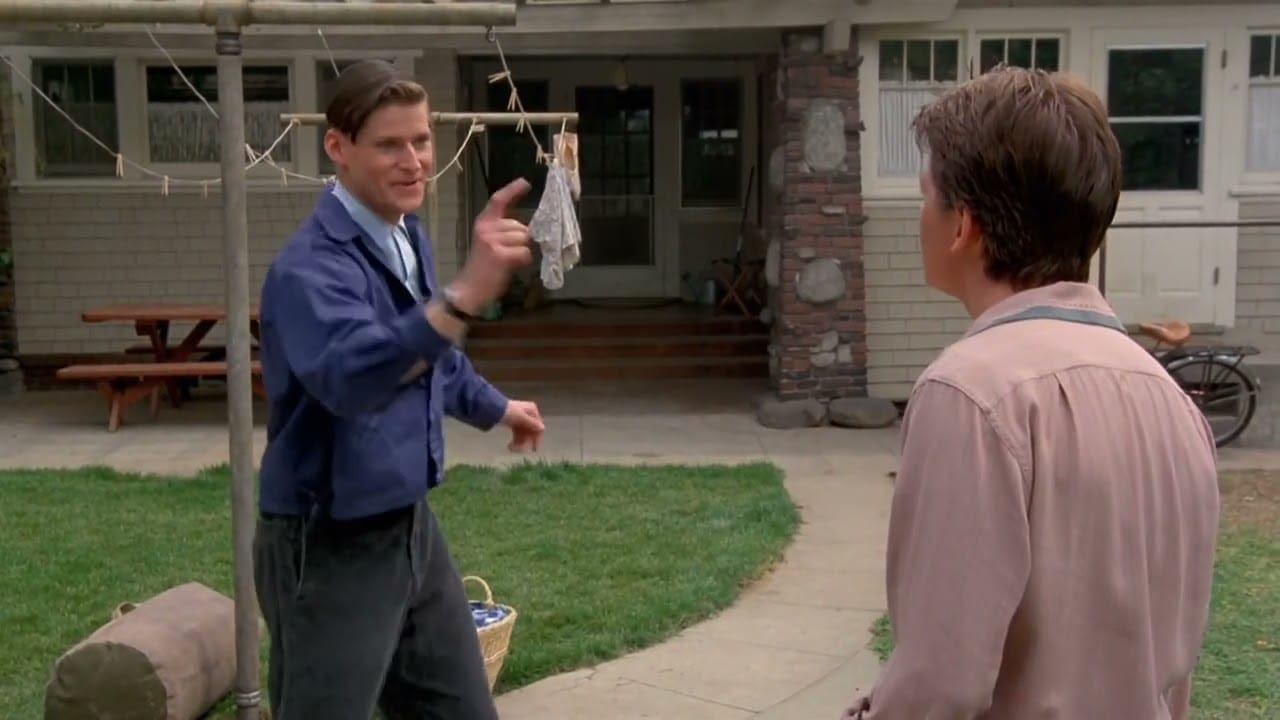
Running out of time and running out of ideas, Marty sets up a scene for his not-yet-dad George to look like a hero and take Marty's not-yet-mom Lorraine to the dance. Because Lorraine has already asked Marty to the dance (and the story is dangerously close requiring Sophocles to get a Story By credit), Marty decides to pretend to assault Lorraine and let George punch him out and come to her rescue.
He even gives him a line to say: "Hey you, get your damn hands off her."
There are many potential problems with this plan, but none larger than George's actual Bully Biff Tannen showing up, throwing Marty in the trunk of a car, and taking Marty's place in the car with Lorraine.
George goes ahead with the plan
Sure, there's a setback when George freezes upon seeing Biff in the car and realizing Lorraine is in real danger. And yes, Biff does start with the upper hand by twisting one of George's arms...
But he forgets that George has two arms, and that other one's a fightin' arm.
It's a perfect example of giving the audience What They Expect, but not How They Expect It.
Finding the courage to go off script
Marty's plan would make George look brave. George realizing he actually needs to stand up to Biff and following through? That shows George learning to actually be brave. That moment adds meaning. Biff's not just about to get punched, but he's going to get punched by someone who's not afraid of him anymore.
Uncertainty
George takes his first swing and Biff blocks it. Even though he's not backing down, the audience still isn't sure that seal the deal.
Also, before George can get out of the armlock, Marty gets released from the car trunk. He's rushing to get back. Will he be the one who saves George?
Hubris, they name is Tannen
Lorraine tries to help, and Biff shoves her to the ground. He's feeling big. In charge. Unstoppable. He sneers and laughs just long enough to get distracted. Because a bully who's had plenty of time to feel unbeatable is more likely to believe their own hype.
POW! WHAM! KA-CHONK!
George was never weak. That wasn't why Biff could bully him for so long. George was scared. George believed he couldn't stand up to Biff. He puts it all into one punch, and it's the only punch that matters.
Because that's the moment that George shows Marty he doesn't need saving. That's the moment he shows Biff not to underestimate him. And that's the moment that Lorraine sees George take that first step into being the person he's capable of being.
Now we enter the endgame...
Marty's had two problems since accidentally landing in 1955: Fix the time machine so he can get back to 1985, and make sure that his future parents kiss at the Enchantment Under the Sea dance so that he doesn't stop existing.
George overpowering Biff brings everything one step closer to success for Marty, because it puts Lorraine and George together on the dance floor, right where Marty needs them to be.
Matilda
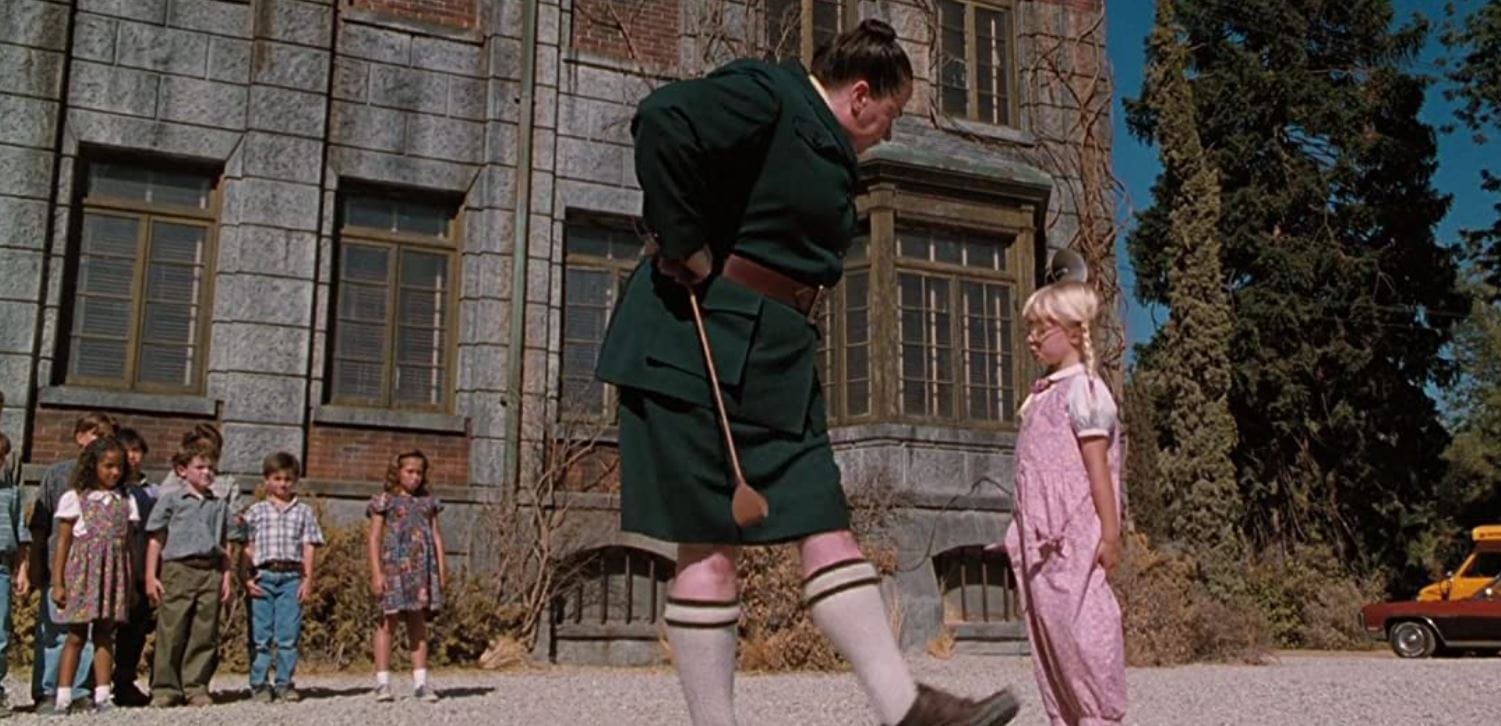
Miss Trunchbull. The school's headmistress does double duty as the school bully. She torments children and teachers alike, not just the story's protagonist.
So when Matilda decides to unleash her full power to retaliate, the audience has a plethora of reasons to lean back and let the schadenfreude wash over them. Here's what they see:
It's not a strength competition
We know Trunchbull is big and strong and Matilda is small and physically weaker, so Matilda's plan requires other skills. Telekinesis is one thing, but it's also how Matilda uses personal information to create a convincing haunting to frighten this bully to her core.
Undercutting the bully's strength
Trunchbull tries to launch a kid out the window? Matilda flies the kid around like a superhero and back toward his assailant. Trunchbull goes to grab another child? Matilda lifts the girl out of the way to discombobulate the attacker. The tactics that Trunchbull relies on, brutalizing kids with her superior size and strength, are negated.
What does the bully fear?
Children laughing. Children laughing at her. Because sure, having lunches chucked at her is gross and demoralizing, but not being able to control the children or control how they see her is something that snuffs out the fire burning in the heart of this bully.
Resolving the central tension
Matilda focuses on the conflict between adults and children, and Matilda facing obstacles set by many of those adults in her life to prevent her from becoming the unique, bright, powerful person ready to burst out. Driving Trunchbull out of the school makes space for Miss Honey to take control of the school, take back her home, and take custody of Matilda.
Fighting back against this bully matters in a big way.
A History of Violence
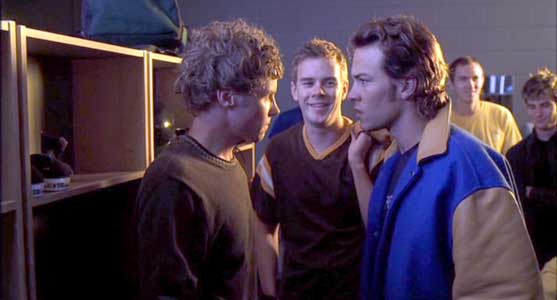
Jack's father Tom becomes a local celebrity after foiling an attempted robbery in his diner with lethal force. Seeing this as another reason to needle Jack at school, bully Bobby decides to pick up where he left off in the locker room the other day.
This doesn't go well for Bobby, but not in the ways he (or the audience) might expect:
Acting out of character
In a previous scene, Jack used humor to deflate Bobby and move on. But today feels different. Today has a different context because Bobby's bringing Jack's dad into it, connecting violence to strength and (more importantly) strength and violence to parental approval.
No way out
Bobby's lil' buddy/co-bully blocks Jack's exit. Bobby isn't taking no for an answer. He wants this to get physical and he's not giving Jack a path to leave or de-escalate.
The taunt
Bobby gives that one last push by ridiculing Jack's previous strategy: "Make me laugh." It grounds the reason for the fight (Bobby getting laughed at before because of Jack), with a present-tense challenge.
The brutal awakening
Jack's violence doesn't feel like it was built up to. It's an outburst. It's fast, profane, and bloody. This isn't a moment for the audience to cheer, but to see the brutality rising to the surface. It's a moment that doesn't feel like a required resolution for Jack's story, but a reflection of the larger questions in Tom's story. Is violence something inside all of us? Are some people more predisposed to it? And once you start walking down that path, are you able to change direction?
A lack of anticipation
There's no eager audience for this fight. We see no evidence in the film up to this point that Bobby bothers anybody else. Nobody's cheering as Jack slams Bobby to the ground.
The film's audience isn't being invited to align against Bobby, but to look on in horror like Judy, who tried to pull Jack away before this happened.
One more obstacle
The consequence of this fight comes when Tom chastises Jack for the beating he gave to Bobby.
TOM
In this family, we do not solve our problems by hitting people!
JACK
No, in this family, we shoot them!
Tom's attempt to live a quiet, peaceful life with his family and leave behind his criminal past is endangered first by killing the men in his diner, but also by Jack's actions with Bobby. It threatens Tom's attempts to break the cycle of violence with his own children, and it also directly threatens their lives and safety after this argument with Jack.
Jack runs away from this confrontation, allowing him to get kidnapped by the people hunting Tom down. The bully gets a beating, but it doesn't come with the emotional uplift of a fight worth having for the sake of the larger story.
Takeaways
- How strongly does fighting back against the bully relate to the protagonist's main goal? Is this a necessary step along the path, or a potential setback?
- An audience might cheer on a bully getting what for, but who in the story wants to see this bully get their comeuppance?
- Is the moment a culmination that's been building over the course of the whole narrative, or something earlier on? Does conquering the bully feel like a final victory, or a temporary change in power dynamics?
- How does your character fight back? Does the bully still have "home field advantage," or has the character found a way to change the type of conflict to one that fits their specific strengths?