Insidious Root Beer: Writing conversations with bite
Sometimes it falls on the writer to make two people sitting and talking a dynamic scene that pulls the audience in. We look at one such scene from Star Trek to find some potential writing strategies.

Sometimes characters need to talk it out. Or sometimes your episode is running a little short and you only have the budget for a little shot-reverse shot chat.
There are ways to liven up dialogue with activity, like having characters walk-and-talk, or find a unique activity (like going to the batting cage), but when done well, the conversation itself can have plenty of fireworks.
Let's take a quick trip to Star Trek: Deep Space Nine.
A Cardassian walks into a Ferengi's bar...
A little context
The titular space station acts as a major interstellar hub because of a stable wormhole nearby. Trouble is, on the other side of that wormhole lives The Dominion, an ever-expanding empire of planets and systems.
In this episode, war between The Dominion and the different factions of the Alpha Quadrant has fractured alliances. The Klingons end a decades-old treaty with the Federation in order to try and conquer Cardassian territory (using the pretense that the Cardassian rulers have been infiltrated by the Dominion).
Basically, everyone is fighting with everyone else, and nobody is sure who will come out on top.
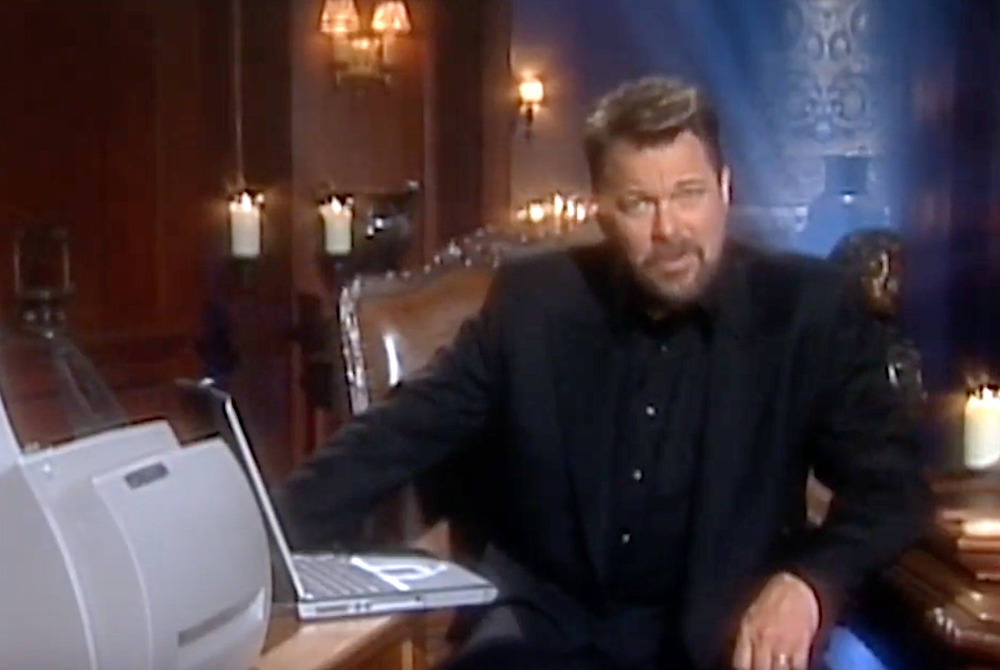
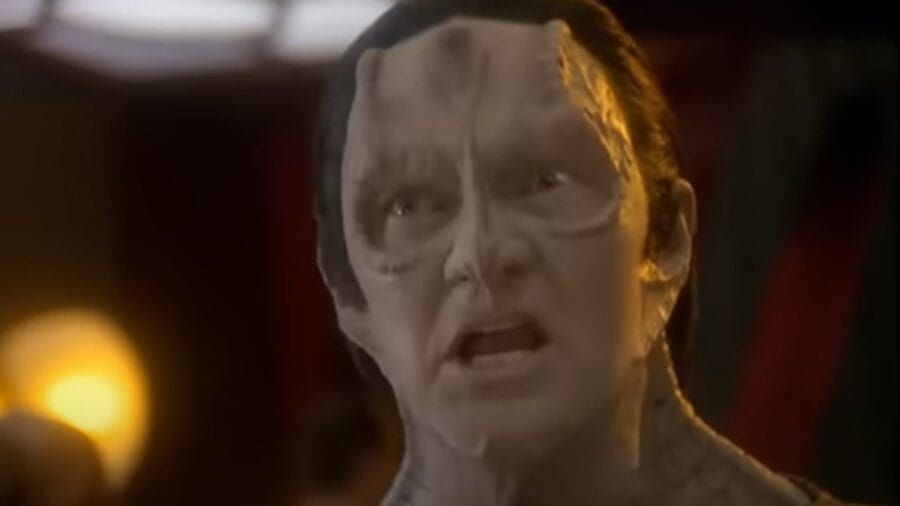
Which brings us to Quark, the Ferengi bar owner, and Garak, the station's resident tailor and an exiled Cardassian, taking stock of their lot in life.
Outsider perspective
Neither Quark or Garak are central characters to most of the show's drama. An episode might revolve around one of them. While there are a few exceptions, they're not usually making decisions that decide the fate of millions of lives.
They're both separated from their homeworlds on a Federation-controlled station, and the Federation is majority Human in its ranks. This gives Quark and Garak ways of seeing the story differently than the rest of the regular cast: They are neither human, nor enlisted in Starfleet.
Those identities give them specific opportunities to see shades of the story that could go unnoticed by Star Trek's regular crew of duty-bound, conflicted-do-gooder heroes. Putting the two of them together provides space where they can both express those feelings and ideas openly.
Choosing the setting
It's a bar. You don't have to come up with a crucial, plot-driven justification for the two of them talking here.
Garak wants a drink, and Quark pours the drinks here.
But this also offers some additional opportunities to keep the scene dynamic and specific...
Props are your friend
Is it good for actors to have something physical to focus on? Something to create a little bit of business in a scene that doesn't call for a lot of motion? Absolutely.
But the prop can motivate the conversation itself. Garak doesn't just want a drink, he wants a Cardassian drink (Kanar), which leads Quark to muse about how the lack of Cardassians on the station leaves him with an excessive back stock of the stuff.
The order motivates the shift in conversation to commerce and to politics.
Conversational flavor (grounded in character)
Ferengi are motivated by profit. They have an entire religion based around a lengthy list of Rules of Acquisition (aphorisms related to business dealings). It makes sense for Quark's mind to turn to a seemingly good business decision turned sour (stocking all that Kanar), and then bemoaning how he could be raking in money as a weapons dealer like his cousin if it wasn't for the fact that he likes interacting with his customers.
Meanwhile, Garak is sitting there thinking about how his homeworld is in crisis and there's nothing he can do. Some characters might get indignant with Quark's petty penny-pinching in the face of war. Not Garak. He's analytical, slow to display his emotions, and sometimes likes to provoke with snide asides to see how others react. It's the former Cardassian Intelligence operative in him.
Going back to their outsider status: Neither one of them would find value in this conversation turning truly antagonistic. Their fight isn't with each other.
Fun with synecdoche
It's not subtle: The root beer is meant to stand in for the Federation.
First, it's something that the human audience of the show is likely familiar with. If you're someone who likes root beer, Garak's visible repulsion to a sip of it plays as funny, but not ha-ha funny in a way that distracts from the meat of the conversation. The tone stays in place.
The root beer itself as a representation of humanity perfectly connects to Quark and Garak's opinions about the human-majority Federation: Cheerful little soldiers inserting themselves and their values into your life, quietly colonizing the galaxy while avoiding the appearance of violent conquest.
That's what makes comment about learning to like root beer so cutting. Acquiring a taste for the drink acts as an analogy for assimilation.
He's acknowledging that their personal fortunes are potentially made better, or at least more stable, with the Federation there. That you can suppress your innate differences with the Federation.
The smaller conflicts among larger problems
It's easy for stories about war to flash to the front, showing the bombast of combat. In sci-fi, that can mean lots of pew-pew and kaboom.
A scene like this shows the rippling individual costs of war. It reminds the audience that the chain of actions and consequences can extend into all kinds of lives, and all kinds of story areas.
And in using these particular characters, the show raises the tension on the entire arc of the war's story. The cynical Quark reveals that he actually hopes the Federation will pull through and win this war, but he's also wary of their ability to do so.
Takeaways
- There's life to be found even in what feels like a basic shot-reverse shot dialogue scene. It comes from defining the characters doing the talking, and how their conversation connects to the larger story.
- Conflict motivates a scene, even when it's subtle. This isn't a stretch of two characters giving directionless musings about the Federation. Quark has a point to make to Garak, and he twists Garak's arm a little to convince him to try the human drink as a strategy. It's an act of persuasion, negotiating an understanding between the two of them.
- Don't overlook characters in a war story who aren't fighting on the front lines. Seismic shifts can rattle people far from the epicenter. How can you show it?
- Complexity builds when characters show they're capable of holding opposing thoughts at the same time. But they need a reason, and they need to be in proportion. In this example, Quark can't both hate and love the Federation, but it feels reasonable for him to distrust it while also seeing it being good for business.